


There is a noticeable shift between babyproofing for a crawler and trying to toddler proof stairs for a child who can pull up, climb, and test every boundary in sight. The gate that felt adequate a few months ago may now be something your toddler leans on, rattles, or studies like a small climbing wall. The safest approach combines a stair-appropriate physical barrier, a design that does not invite climbing, regular installation checks, and supervised practice with the stairs themselves.
For toddlers, a stair gate is not a substitute for adult supervision. It is a practical layer of protection that helps manage access while your child is still learning balance, judgment, and safe stair habits. The CDC advises parents of one- and two-year-olds to block off stairs with a small gate or fence as children become more mobile and encounter more hazards.
Ready to upgrade your toddler's stair safety? Browse The Stair Barrier climb-deterrent fabric gates designed for modern homes.
Why Do Basic Baby Gates Fail Once Toddlers Start Climbing?
Toddlers are built to explore. As they become more independent, the staircase often becomes both fascinating and newly accessible. A child who was once content to crawl nearby may begin pulling on a gate, trying to step up on a lower rail, or reaching for the top. The shift from crawler to climber happens quickly, often between 9 and 15 months, and many parents discover their current gate is no match for a determined toddler.
A toddler proof stairs strategy starts with understanding what makes a gate climbable. Horizontal bars, wide openings between rails, and furniture nearby can all turn a barrier into a challenge. Research on unintentional injuries in young children identifies stair gates as an important protective factor for stair falls. But a gate is only protective when it is correctly chosen for the child's developmental stage.
Direct answer: Basic gates fail with climbing toddlers because they rely on height alone and ignore footholds, leverage points, and the child's growing strength. A climb-deterrent design eliminates horizontal rails, uses a smooth surface, and secures tightly to the mounting points so the gate cannot be pushed or rattled loose.
Look beyond height alone
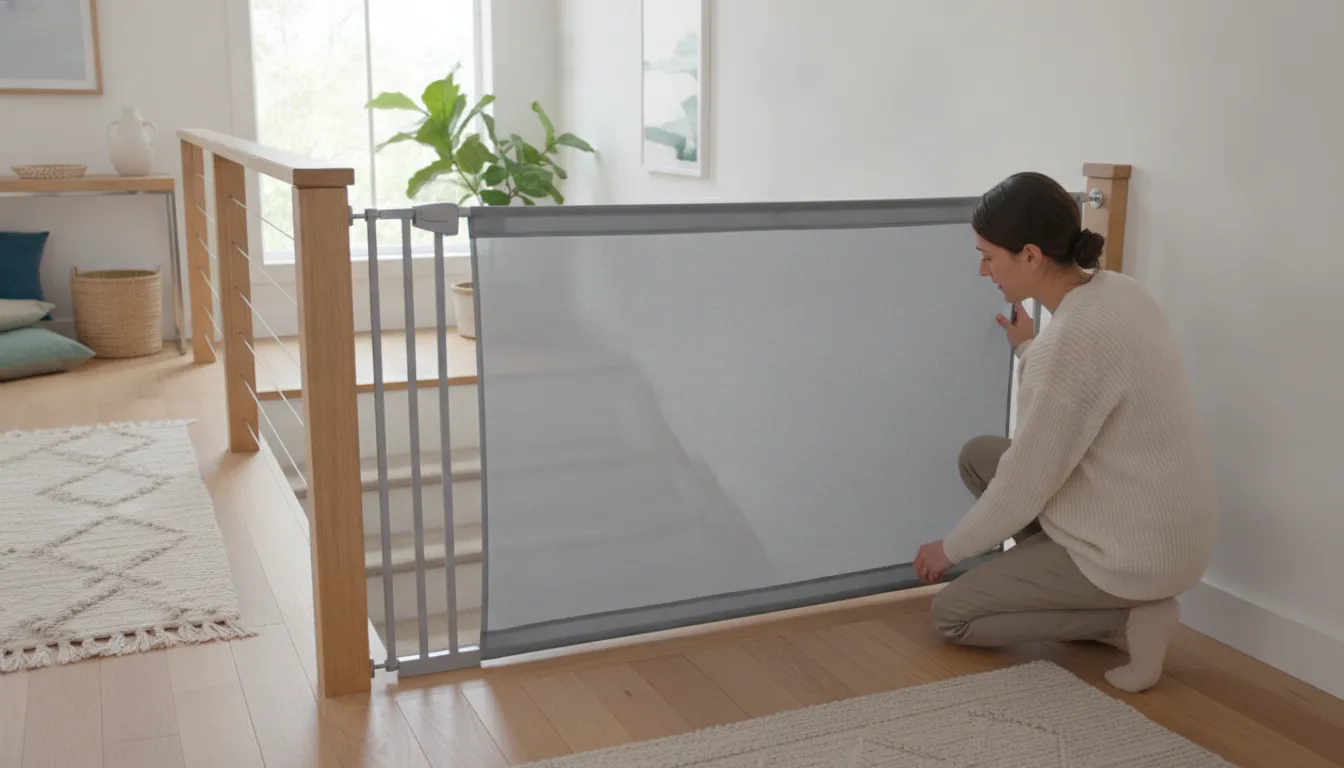
Gate height matters, but it is not the only consideration. A toddler may use horizontal bars, wide openings, nearby furniture, or a loose installation as an opportunity to climb or push. Choose a design that makes the barrier less interesting to scale: a smooth fabric surface and vertical supports give little to use as a foothold compared with a gate that has ladder-like crossbars. The Stair Barrier stands 32 inches high and uses a fabric face with vertical struts, designed to discourage climbing without introducing bulky plastic or metal into the room. It also meets ASTM F1004 safety standards. No barrier can eliminate risk, so continue to supervise your child and follow the product instructions for installation and use.
For a closer look at this specific behavior, read our guide to when your toddler starts climbing a stair gate.
What to Look for in a Toddler-Proof Stair Gate
When you toddler proof stairs, choose for the staircase first and convenience second. A gate used at stairs must suit the opening, the mounting surface, and your child's current abilities. Below are the three most important factors to evaluate before making a purchase.
Direct answer: A toddler-proof stair gate must have a secure hardware-mounted installation, never pressure-mounted at the top of stairs. A climb-deterrent surface with no horizontal footholds, ASTM F1004 certification, and a design that fits your specific stairway configuration.
A secure installation for the location
At the top of stairs, use a gate specifically intended and installed for that location. Pressure-mounted gates can shift when pushed or leaned against, so they are not a suitable choice for top-of-stair protection. Confirm the instructions for your exact gate, wall, banister, and opening before installing it. If your staircase has an unusual angle, a curved post, or an uncertain surface, use measuring guidance or photo-based support rather than guessing.
Schedule a stair safety evaluation with our team to find the right fit for your home.
A climb-deterrent surface
A tall barrier is more effective when it also avoids obvious footholds. Look for a smooth surface or vertical supports rather than horizontal rails that can act like steps. Consider the entire area around the gate, too. Move stools, small chairs, storage bins, and other objects that could help a determined toddler climb.
Safety testing and everyday usability
Check for relevant safety standards, including ASTM F1004, and use the gate only as instructed. Everyday details matter as well: a barrier that is difficult to clean or awkward to live with may be more likely to be left open. The Stair Barrier upholstery-grade fabric is machine-washable and dryer-safe, and the gate can roll to the side when it is not needed.
For more help comparing stair-appropriate options, see our expert picks for the best baby gates for stairs.
Banister-to-Banister vs. Wall-to-Banister: Choosing the Right Fit
The best toddler stair gate is one that fits the real architecture of your home. Many stairways do not offer two flat, parallel walls, which is why a conventional gate can be difficult to place securely. The Stair Barrier offers two configurations designed for the most common stairway layouts.
| Configuration | Best for | Installation | Starting price* |
|---|---|---|---|
| Banister-to-Banister | Stairways with a banister post on each side | Straps around banisters, with no drilling | $119.99 |
| Wall-to-Banister | One wall and one banister | Minimal drilling on the wall side | $147.99 |
*Confirm current pricing and product details on the product page before purchasing.
Banister-to-Banister
A Banister-to-Banister Stair Barrier is designed for openings with a post on each side. It wraps around the posts rather than requiring holes in the wood, making it particularly useful for renters and for banisters with distinctive shapes. The regular size fits openings from 36 to 43 inches; the Wide size fits openings from 43+ to 52 inches.
Wall-to-Banister
A Wall-to-Banister Stair Barrier is suited to an opening with a wall on one side and a banister on the other. It needs minimal drilling on the wall side, while the banister side uses the strap-based system. This can offer a clean solution where a rigid gate does not match the layout.
If you rent or want to avoid unnecessary alterations, our guide to rental baby proofing stairs explains the no-damage considerations in more detail.
How Do You Reinforce a Stair Gate as Your Toddler Gets Stronger?
Toddler-proofing is not a one-time project. As your child grows taller and more determined, the gate that once seemed secure may develop vulnerabilities. Hardware can loosen over time from daily use. Straps can stretch, and a toddler who once could not reach the top of the gate may now be tall enough to get a grip on something new.
Direct answer: Reinforce your stair gate by conducting a monthly five-point safety check. Inspect all mounting hardware for tightness, look for worn webbing or fabric, and verify the gate sits flush and does not sag. Remove any climbable objects within reach and review the manufacturer age and weight guidance to confirm your child has not outgrown the barrier.
Build a quick check into your monthly home-safety routine:
- Check that wall hardware, straps, buckles, and fasteners are secure.
- Look for damaged webbing, worn fabric, loose components, or gaps that were not there before.
- Confirm the barrier sits as directed in the installation instructions and does not sag.
- Remove nearby objects that could become a step stool.
- Review the manufacturer age, height, and use guidance as your child grows.
If anything feels loose, damaged, or uncertain, stop using the gate until you can correct the issue. A safer installation is always more important than forcing a fit.
Teach Stair Safety Skills Alongside Physical Barriers
A gate manages access; it does not teach judgment. Toddlers still need calm, repetitive instruction for the times they use the stairs with you. The goal is not to rush independence. It is to build predictable habits while you are close enough to help.
Direct answer: The most effective stair safety teaching method for toddlers is consistent supervised practice with one instruction at a time combined with a reliable physical barrier for the moments when supervision is not possible. Children learn safe stair habits through repetition, modeling, and clear boundaries.
- Practice only with an adult present. Stay close enough to steady your child. Give one simple direction at a time.
- Model safe movement. Toddlers imitate adults and older children. Show them how to slow down, face the steps, and use a handrail when they can reach it comfortably.
- Keep hands free. Carrying toys or oversized items makes balance harder. Teach your toddler to ask for help with anything that needs two hands.
- Keep the staircase clear. Shoes, toys, laundry, and pet items can turn a familiar route into a trip hazard.
- Repeat the boundary. A simple phrase such as "stairs are with a grown-up" is easier for a toddler to learn than a long explanation.
Children develop at different rates, so do not rely on an age alone to decide whether they are ready for independent stair use. Continue to use barriers and supervision whenever access needs to be limited.
Open Stairs, Wide Banisters, and Other Tricky Designs
Some homes call for more than a standard gate. Open risers, wide gaps between railing elements, slick wood treads, and irregularly shaped banisters each need a separate assessment. These architectural features are common in modern and historic homes, and they require specific solutions that go beyond a one-size-fits-all gate.
Open risers and large railing gaps
If your child could fit through or become caught in an opening, consider a properly secured guard or clear panel designed for that purpose. Do not improvise with a loose screen, unstable furniture, or a material that creates sharp edges. A qualified installer can help when the needed modification affects a railing or structural feature.
Slippery steps
For smooth wood stairs, well-secured non-slip treads or a runner can improve traction. Make sure any addition is firmly attached and does not curl at the edges. Keep steps dry and clear, especially near entryways.
Unusual openings
Fabric safety gates can be especially useful on non-standard openings because the installation can be configured for banister-to-banister or wall-to-banister layouts. Still, the correct product and fit depend on your measurements. Review the measuring instructions or contact support with photos before ordering if your setup is unusual.
Frequently Asked Questions
Should a toddler still have a stair gate?
Many toddlers still need controlled stair access because physical ability often develops faster than judgment. Use a barrier appropriate for the location and your child abilities, and continue adult supervision.
Can I use a pressure-mounted gate at the top of stairs?
No. Do not use a pressure-mounted gate at the top of a staircase. Choose a gate intended for stair use and install it according to its instructions.
How can I stop my toddler from climbing a gate?
Choose a tall, climb-deterrent design without horizontal footholds, remove nearby climbable furniture, inspect the installation regularly, and teach a consistent stair boundary. Supervision remains essential.
Do I need gates at both the top and bottom of the stairs?
Consider the access points your toddler can reach and the layout of your home. The top of stairs requires particular care. Follow the gate manufacturer guidance for every location.
What if I am not sure which Stair Barrier fits?
Do not guess. Measure the opening and use The Stair Barrier installation resources or photo-based support to confirm whether Banister-to-Banister or Wall-to-Banister is appropriate.
Build a Safer Stair Routine Without Compromising Your Home
When your toddler becomes a climber, the right response is not panic. It is a better system: a secure stair-appropriate barrier, a surface that does not invite climbing, a regular installation check, and clear habits practiced with you nearby. The Stair Barrier brings these practical needs together in a premium fabric safety gate designed for homes that live beautifully.
Ready to toddler proof your stairs with a premium climb-deterrent gate? Shop The Stair Barrier Banister-to-Banister and Wall-to-Banister configurations today. Safe Never Looked So Good.

Written by Arden Vale
Design & Safety Specialist
Arden provides expert guidance on blending ASTM safety standards with modern interior styling, helping parents and pet owners create secure, beautiful spaces.