


A baby gate with door can make a busy doorway easier to cross, until its swing arc collides with a wall, its floor bar catches a hurried foot, or its rigid frame refuses to cooperate with a banister. A roll-aside fabric barrier solves a different set of problems. It clears the walking path when open, adapts to stair configurations, and feels more at home in a carefully designed room.
Compare The Stair Barrier fabric safety gates for your staircase or doorway.
A baby gate with door is best when frequent one-handed walk-through access matters and there is enough room for the door to swing. A roll-aside fabric barrier is often the better fit for banisters, narrow landings, and design-conscious homes because it stores to the side without leaving a rigid frame in the path.
The right choice depends on the opening, mounting surfaces, traffic pattern, and people using the space. This guide compares both formats so you can choose a gate based on how it will work in your home, not simply how it looks in a product photo.
Baby gate with door vs fabric barrier at a glance
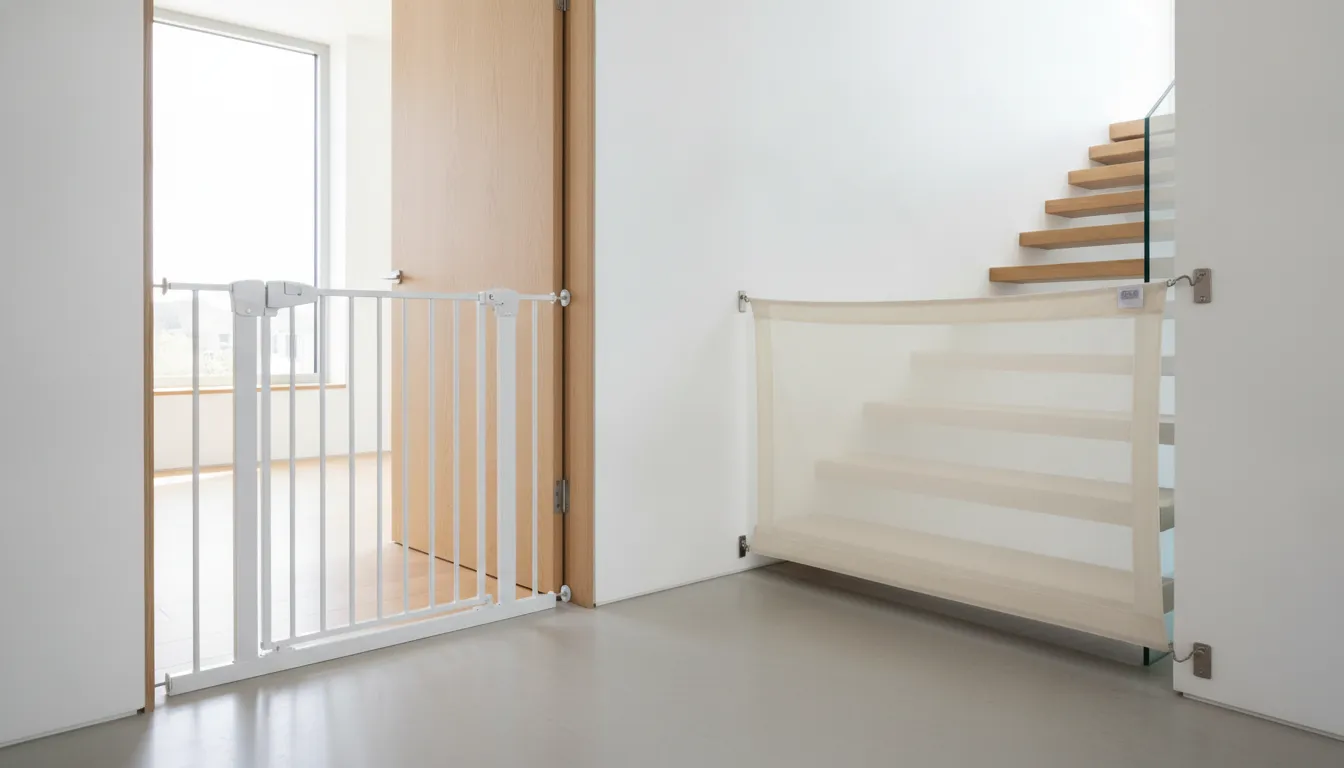
A walk-through gate and a fabric barrier can both create a boundary, but they handle access in fundamentally different ways. A gate with a door keeps a rigid frame in place and opens a hinged panel inside it. A roll-aside barrier releases from one side and stores beside the opening.
| Decision point | Baby gate with door | Roll-aside fabric barrier |
|---|---|---|
| How it opens | A hinged panel swings within a rigid frame | The panel releases and rolls to the side |
| Space when open | Needs a clear swing arc; some frames leave a floor bar | Stores beside the opening and clears the path |
| Typical fit | Works well between compatible flat surfaces | Available for banister-to-banister and wall-to-banister openings |
| Cleaning | Usually wiped by hand | The Stair Barrier fabric is machine-washable and dryer-safe |
| Visual effect | Usually metal, plastic, or wood | Upholstery-grade fabric in more than 20 options |
| Best reason to choose it | Frequent pass-through access with room to swing | Stair-focused fit, clear open path, and softer home styling |
Neither style is automatically right for every location. Begin with the opening itself, then consider how often the barrier will be opened, whether a swinging panel would interrupt traffic, and how the selected model is intended to mount.
How does a baby gate with door work?
A baby gate with door places a hinged walk-through panel inside a frame. The frame stays across the opening while an adult operates the latch and swings the door open. This familiar design can be convenient between rooms that adults cross frequently, especially when there is generous clearance on one side.
Latch and frame design
Walk-through models use different latch systems. Some require two coordinated actions to open, while others are designed for one-handed adult operation. The usable passage is narrower than the full opening because the frame and hinged panel occupy part of the width. That detail matters when carrying laundry, moving furniture, or walking through with a pet beside you.
Some models include a threshold bar at floor level. It reinforces the frame, but it also remains in the path while the door is open. Before buying, look closely at product photos and installation instructions so you know whether a floor bar is part of the design.
Swing clearance and traffic flow
The door needs an unobstructed swing arc. In a spacious doorway, that may be easy to accommodate. On a tight landing, beside a wall, or near furniture, the panel may hit another surface or force adults to step around it. Map the arc with a tape measure before deciding that a hinged gate will fit.
Also consider which direction the gate is designed to swing. A product used near stairs must be installed exactly as its manufacturer directs for that location. Do not assume that a model suited to a hallway is suited to the top of a staircase.
Where this style makes sense
- A flat wall-to-wall opening with compatible mounting surfaces
- A room entrance adults pass through many times each day
- An area with enough clear floor space for the full door swing
- A location where the specific model is approved for use
A hinged walk-through is a practical format when those conditions align. When they do not, its defining feature, the swinging door, can become the source of daily frustration.
What is a roll-aside fabric barrier?
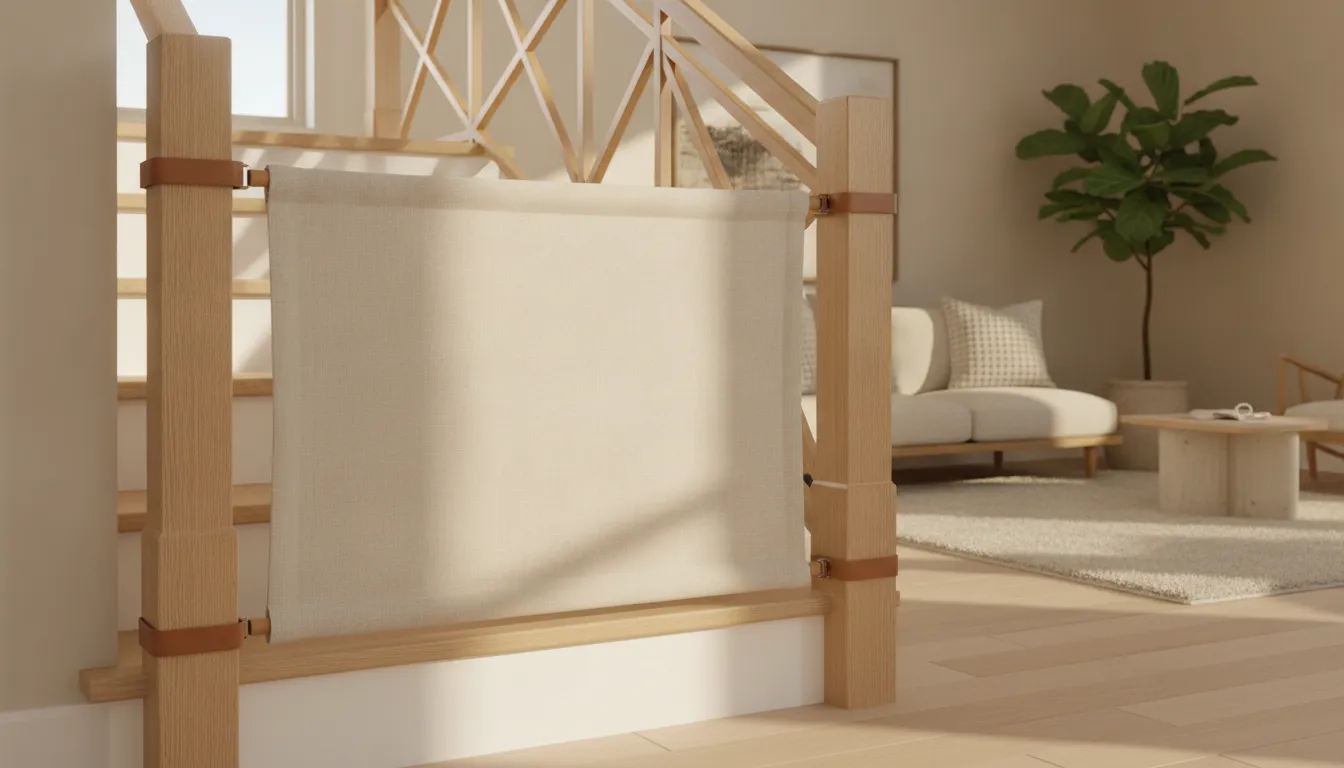
A roll-aside fabric barrier creates a firm boundary across an opening without a hinged walk-through panel. To open the path, an adult releases one side and rolls the fabric panel toward the opposite side. The result is a clear route without a door projecting into the room.
How The Stair Barrier differs
The Stair Barrier is a premium fabric safety gate designed for families and pet owners who do not want home safety to look purely utilitarian. Its fabric construction, roll-to-side storage, and upholstery-grade options support the brand idea that Safe Never Looked So Good.
The fabric is machine-washable and dryer-safe, which is useful in a high-touch home with children or pets. More than 20 fabric options allow the barrier to coordinate with surrounding finishes instead of introducing a bulky metal or plastic structure.
Banister-focused configurations
The Banister-to-Banister model wraps around banisters and requires no drilling. It is designed for openings with posts on both sides, including many curved or non-standard banister shapes. The Wall-to-Banister model is intended for an opening with a wall on one side and a banister on the other; it requires mounting on the wall side.
Those configurations address a common problem: many conventional gates are designed around two flat, parallel walls. If your staircase has posts, trim, angles, or an uneven opening, choose by the actual surfaces you have rather than trying to force a generic gate into the space.
Roll-aside is not the same as retractable
A roll-aside panel is moved and secured by hand. It does not retract into a spring-loaded housing. That distinction affects how the product opens, where its components sit, and how it stores. When comparing products, confirm whether the panel rolls manually, retracts mechanically, or swings on hinges.
Which gate style fits your space?
Fit should drive the decision. The most attractive or convenient gate cannot perform as intended if it is installed in an incompatible opening. Measure carefully, identify each mounting surface, and follow the instructions for the exact model you choose.
At the top or bottom of stairs
Stair locations deserve extra care because a loose or poorly placed barrier can add risk rather than reduce it. Pressure-mounted gates should not be treated as a top-of-stairs solution. Choose a product specifically intended for your stair location and mounting surfaces, then install it according to the manufacturer's directions.
A roll-aside format is appealing on a landing because it does not need a swing zone and leaves no rigid door projecting over the path. The correct configuration still depends on whether the opening has two banisters, a wall and a banister, or another arrangement.
Between rooms and in narrow hallways
A baby gate with door can work well in a broad, flat-sided doorway with room for its panel to move. In a narrow hallway, the same panel may interrupt the route every time it opens. A roll-aside barrier preserves more usable space when open, making it worth considering for compact layouts and high-traffic paths.
A quick fit checklist
- Measure the opening at the points specified by the product instructions.
- Identify what is on each side: wall, banister, trim, or another surface.
- Check for baseboards, unusual post shapes, and angled openings.
- Mark the proposed swing arc if considering a hinged gate.
- Confirm that the exact product is intended for that location.
- Ask for fit guidance rather than guessing when the opening is unusual.
The Stair Barrier offers separate Banister-to-Banister and Wall-to-Banister options. Comparing your opening with those configurations is more reliable than shopping by width alone.
Which option is easier to live with every day?
Daily convenience is more than how quickly a gate opens. It includes the route adults take through the home, how the gate behaves while open, how easily it can be cleaned, and whether it remains visually comfortable after months of use.
Opening the path
A hinged door keeps the frame in place and may be quick to latch after each pass. That can suit a doorway crossed repeatedly. However, it also requires adults to operate the latch and move through a narrower panel while managing the swing.
A roll-aside barrier opens the entire route and stores beside it. This can be helpful when guests arrive, when bulky items need to pass, or when the barrier is not needed for part of the day. The tradeoff is that an adult must release and secure the panel rather than simply swing a door.
Cleaning and long-term appearance
Rigid gates typically need to be wiped around bars, hinges, latches, and joints. Fabric introduces a different maintenance routine. The Stair Barrier fabric panel is machine-washable and dryer-safe, allowing families to refresh it after contact with sticky hands, pet hair, or everyday dust.
Material also changes the feel of the room. A metal or plastic frame makes a strong visual statement even when open. A fabric barrier offers color and pattern choices that can coordinate with a rug, upholstery, or surrounding finishes. For design-conscious parents, that difference is part of everyday usability rather than a cosmetic afterthought.
Portability
Rigid frames can be awkward to move once installed. A lightweight fabric barrier is easier to pack for a visit or trip, provided the destination has a compatible opening and the product is installed correctly there. Portability is useful, but it does not replace the need to check fit every time.
How to choose between a baby gate with door and fabric barrier
Use a location-first decision process. Instead of asking which gate style is best in general, ask which one is designed for the exact opening and routine in front of you.
- Choose a baby gate with door when you have compatible flat surfaces, frequent pass-through traffic, and ample space for a hinged panel.
- Choose a roll-aside fabric barrier when you have banisters, limited swing clearance, or want the full path clear while the barrier is open.
- Prioritize the correct model when the location is near stairs. Follow its stated use and installation directions.
- Factor in maintenance if children, pets, or high traffic make easy washing important.
- Consider the room if a permanent rigid frame would disrupt the space even while open.
If your opening has two banisters and you want to avoid drilling into them, the Banister-to-Banister fabric safety gate is the natural product to evaluate. If there is a wall on one side, compare the Wall-to-Banister model instead. For an unusual opening, request measuring or photo-based support before ordering.
See the Banister-to-Banister fabric safety gate for a drill-free banister installation.
Safety and installation considerations
Any safety gate is only one part of a safer home. Select an appropriate product, install it correctly, inspect it regularly, and continue active adult supervision. The Stair Barrier meets ASTM F1004 safety standards, but no gate eliminates every risk or replaces an attentive caregiver.
Before installation
- Read the full instructions for the exact model.
- Confirm that the location and surfaces are compatible.
- Measure rather than estimating the opening.
- Keep the area around stairs and the gate clear.
- Do not substitute a pressure-mounted gate where a secure stair solution is required.
After installation
Check the attachment points, buckles, latch, fabric, and surrounding surfaces regularly. Recheck the fit after travel, cleaning, or any change to the opening. Stop using the barrier if a component is damaged or the fit is no longer secure, and consult the manufacturer for next steps.
The CPSC overview of the ASTM gate standard provides useful background on gate and enclosure requirements. Product-specific directions should guide the actual installation in your home.
Frequently asked questions
Are pressure-mounted baby gates with doors safe for the top of stairs?
Do not treat a pressure-mounted gate as a top-of-stairs solution. Choose a gate specifically intended for that stair location and mounting surfaces, then install it exactly as its manufacturer directs.
Does a roll-aside fabric barrier leave a floor bar?
A roll-aside fabric barrier opens by releasing and rolling the panel to the side, so it does not leave the rigid walk-through frame or threshold bar associated with some hinged gates. That clear-path design can be especially helpful on a tight landing.
Can a fabric safety gate attach to banisters without drilling?
The Stair Barrier Banister-to-Banister model wraps around banisters and requires no drilling. Its Wall-to-Banister model uses mounting hardware on the wall side. Always choose the configuration designed for your opening.
How do I know which baby gate style fits my stairs?
Measure the opening, identify the surfaces on both sides, note unusual post shapes or angles, and confirm the exact product is intended for that location. Request fit or photo-based support when the opening is unusual rather than guessing.
Find a barrier that fits your home
The best choice is the one that fits the opening, supports your routine, and is installed as intended. A baby gate with door remains useful where a hinged panel has room to work. For banisters, narrow landings, and homes where a rigid frame feels out of place, a roll-aside fabric barrier offers a thoughtful alternative.
Shop The Stair Barrier collection and choose the configuration made for your space.

Written by Arden Vale
Design & Safety Specialist
Arden provides expert guidance on blending ASTM safety standards with modern interior styling, helping parents and pet owners create secure, beautiful spaces.