


A child proof banister to banister gate for a wide opening has to do more than span the distance. It needs to match the measured opening, work with the shape of both banisters, and close in a way adults can operate consistently. This guide explains what to check before choosing a banister-to-banister gate, including measuring, buckle operation, fit, and everyday use.
Explore The Stair Barrier Banister-to-Banister Gate
Start with the opening, not the gate
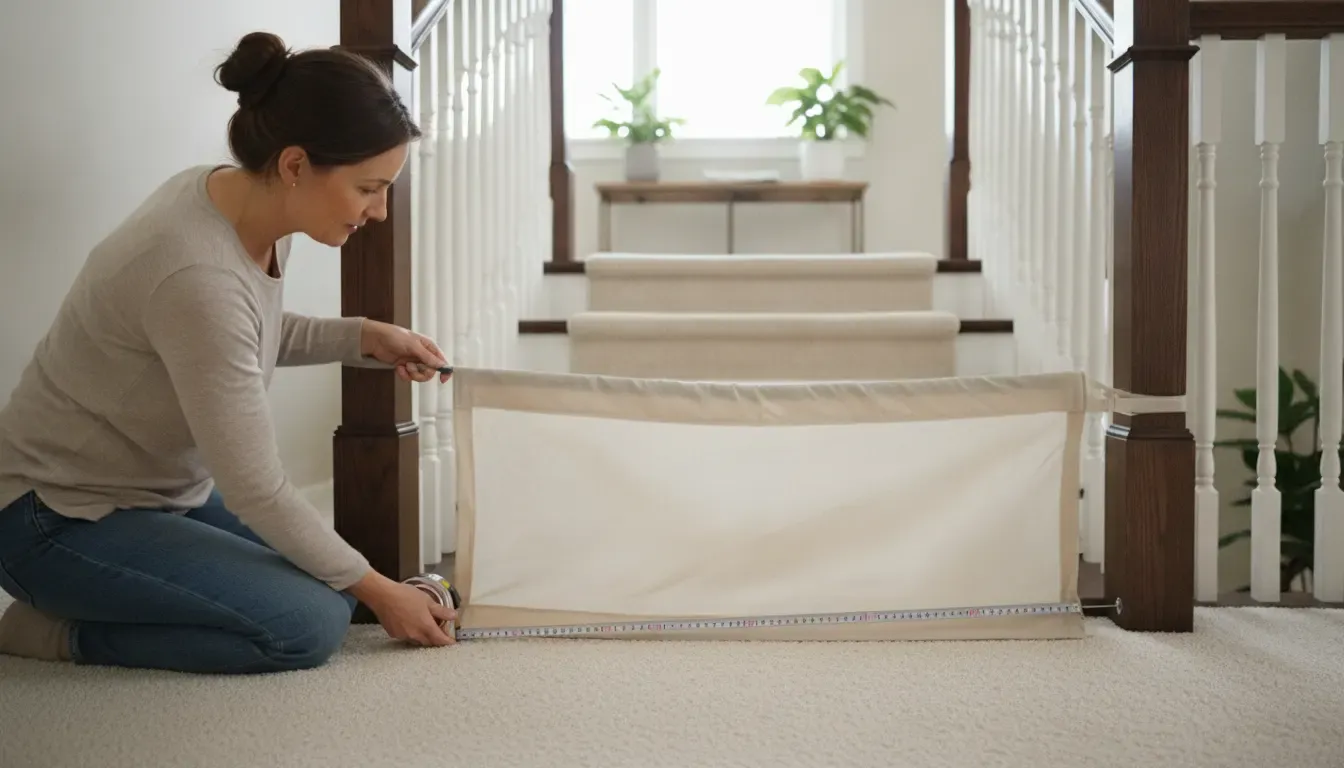
A wide stair opening should be measured at the surfaces where the gate will attach. For a banister-to-banister installation, that means measuring from the innermost edge of the first banister to the innermost edge of the second banister. The measurement determines whether Regular or Wide is the appropriate starting point.
Do not estimate from the overall staircase width, the outside of the newel posts, or the length of the handrail. Those reference points can make the opening appear wider or narrower than the actual mounting span. The Stair Barrier's fit and sizing guide provides the brand's measurement points and explains how to submit a photo when the layout is difficult to judge.
What makes a gate child proof at a banister-to-banister opening?
A child proof gate is an access-control product that creates a physical boundary when it is correctly selected, installed, closed, and used. It is not a promise that a child cannot reach the stairs, and it does not replace adult supervision or a permanent code-required guard or handrail system.
When evaluating a banister-to-banister gate, look for an operation sequence that is clear to the adult using it every time. The Stair Barrier Banister-to-Banister model uses three dual-sided release buckles. The practical questions are whether each buckle is fully engaged, whether the adult can release and secure it without improvising, and whether the gate is closed whenever the opening needs to be restricted.
- Clear boundary: The gate should cover the measured opening without leaving an unplanned access route at either side.
- Deliberate operation: The release mechanism should require an adult action rather than being easy to operate accidentally.
- Secure attachment: Follow the supplied instructions for the specific banister and installation configuration.
- Repeatable use: Build a habit of checking closure and buckle engagement after opening the gate.
How should you measure a wide opening?
Measure the opening before selecting a color or placing an order. A useful measurement is taken at the intended attachment points, recorded in inches, and checked against the manufacturer's published size range. If the staircase has curved or volute banisters, the correct reference points may be different from a straight, square post.
- Identify the two banisters where the gate will attach.
- Measure from the innermost edge of one banister to the innermost edge of the other.
- If the banisters are volute or curved, follow the fit guide's spindle-to-spindle measurement reference.
- Record the result and compare it with the product's Regular and Wide ranges.
- Take clear photos of both attachment areas if the shape, angle, or surrounding rail makes the measurement uncertain.
Measure twice before relying on a result. A tape measure can be held at a slightly different point on a curved banister, and a small change in the reference point can change the size category. For an unusual staircase, a photo-based fit review is safer than guessing.
How do banister shapes affect fit?
Banister shape affects where the attachment point can be identified and measured. The Stair Barrier states that its banister-to-banister gate can adapt to volute, curved, and other banister shapes, but the opening still needs to be measured using the appropriate reference points. Shape flexibility is not a reason to skip the fit check.
Use this simple decision table as a starting point:
| Staircase condition | Measurement focus | Best next step |
|---|---|---|
| Straight banisters with clear posts | Innermost edge to innermost edge | Compare the result with Regular or Wide sizing |
| Volute or curved banisters | Spindle-to-spindle reference shown in the fit guide | Send photos if the attachment point is not obvious |
| Angled or unusual stair opening | Actual intended attachment points and angle | Review installation guidance and request fit support |
| Opening outside the published range | Do not stretch or modify the size range | Contact support before purchasing |
Never modify a gate, hardware, or banister to force a fit. If the opening has a structural issue, an unusual railing arrangement, or a question about building-code requirements, ask a qualified professional for the appropriate advice.
Regular or Wide: which size matches?
The Stair Barrier publishes two standard sizes for its banister-to-banister gate. Regular is for openings from 36 inches to 43 inches. Wide is for openings from over 43 inches up to 52 inches. Use the measured opening, not the appearance of the room, to choose between them.
| Size | Published opening range | Who should consider it |
|---|---|---|
| Regular | 36 inches to 43 inches | Homes whose measured banister-to-banister opening falls within this range |
| Wide | Over 43 inches to 52 inches | Homes whose measured opening is wider than 43 inches and no wider than 52 inches |
An opening of exactly 43 inches falls within the Regular range. An opening wider than 43 inches and no wider than 52 inches falls within the Wide range. If the opening is smaller than 36 inches or wider than 52 inches, do not assume the gate can be adapted. Ask The Stair Barrier Support Team about the specific layout instead.
What should you check before using a child proof gate?
Before relying on a gate, confirm that it is the right product for the location, installed according to its instructions, and operating as intended. The Stair Barrier states that its gates meet ASTM F1004 safety standards. ASTM describes F1004 as a consumer safety specification covering minimum performance requirements, test methods, and labeling and instructional material for expansion gates and expandable enclosures.
- Confirm the selected configuration and size match the measured opening.
- Install the gate according to the supplied product instructions.
- Check that attachment points are secure and that no component is loose or damaged.
- Operate every buckle and confirm it is fully engaged before stepping away.
- Inspect the gate periodically, especially after moving, cleaning, or changing the staircase setup.
- Stop using the gate if it no longer closes or latches as intended.
- Continue supervising children. A gate is one layer of home safety, not a substitute for supervision.
Read the ASTM F1004 standard overview for the scope of the specification. A safety standard does not make every installation identical, and it does not replace local requirements for permanent stair guards, handrails, or other structural fall protection.
Why choose a fabric gate for a wide stairway?
A fabric safety gate can provide a practical boundary without adding the visual weight of a bulky plastic or metal gate. The Stair Barrier is designed for homes where child and pet safety needs to work with the room's existing style. Its fabric construction rolls to the side when not in use and is lightweight enough to be more portable than many fixed-feeling alternatives.
The brand offers more than 20 upholstery-grade fabric options, along with machine-washable and dryer-safe fabric choices. Those features matter in a busy home, but they should come after the fit decision. For broader context on the configuration and its no-drill positioning, read the existing Banister-to-Banister safety guide. A beautiful fabric cannot correct a wrong measurement or an installation that does not match the instructions.
When should you ask for fit support?
Ask for help before ordering when the measurement is close to a size boundary, the banisters curve or wrap around the stairs, the opening is angled, or the attachment surfaces are difficult to photograph. The Stair Barrier specifically directs shoppers to its measurement resources and photo-based support for unusual fits. A clear photo of each banister, the full opening, and the tape measure at the intended reference points gives the support team useful context.
For installation planning, review the installation video and the buyer's guide. These resources can help you understand the configuration before you buy, while a direct fit review can address the details that a general article cannot.
Find the right Banister-to-Banister fabric gate for your opening
Frequently asked questions
Can a banister-to-banister gate fit a wide stair opening?
Yes, The Stair Barrier Banister-to-Banister gate is offered in Regular for 36 inches to 43 inches and Wide for over 43 inches up to 52 inches. Measure the intended attachment points first and request support for unusual layouts.
How do you measure between two banisters?
Measure from the innermost edge of the first banister to the innermost edge of the second. For volute or curved banisters, use the spindle-to-spindle reference in the fit guide rather than estimating from the outside of the posts.
Does a banister-to-banister gate work with curved banisters?
The Stair Barrier states that its banister-to-banister gate can adapt to volute, curved, and other banister shapes. The correct measurement and attachment points still matter, so send photos to support when the fit is not clear.
What should you check after installing the gate?
Check that the attachment points are secure, the gate closes correctly, and every buckle is fully engaged. Inspect the gate periodically and stop using it if it is damaged, loose, or no longer operates as intended.
Can a safety gate replace supervision or a stair railing?
No. A gate can help limit access when correctly selected, installed, and used, but it does not replace adult supervision or a permanent guard, handrail, or other structural fall-protection feature required for the staircase.
Choosing a child proof banister to banister gate for a wide opening is mainly a fit and use decision. Measure carefully, account for the shape of the banisters, confirm the buckle operation, and ask for photo-based guidance when the staircase is unusual. With those checks in place, a fabric stair barrier can add a useful layer of protection while keeping the home feeling like home.

Written by Arden Vale
Design & Safety Specialist
Arden provides expert guidance on blending ASTM safety standards with modern interior styling, helping parents and pet owners create secure, beautiful spaces.