


How long do baby gates last? There is no universal expiration date. A gate can remain useful when it is correctly fitted, securely mounted, and in good condition. But a damaged latch, loose attachment, stretched fabric, or changing child development can make it time to stop using it. This inspection and replacement guide helps you evaluate the gate in front of you, especially when it protects a staircase.
Explore the Banister-to-Banister Stair Barrier for your opening
How long do baby gates last?
Baby gates do not have one fixed service life. Their useful life depends on the gate's materials, how often it is opened and closed. Exposure to moisture or sunlight, installation surface, maintenance, and whether it still matches the child and the opening. Inspect a gate before each use and perform a closer check regularly. Replace it immediately if it is damaged, unstable, recalled, or no longer closes and secures as intended.
A helpful way to answer the question is to separate product condition from child-use readiness. A gate may look new but no longer be an effective boundary for a child who can climb over it, open it, or move it. Conversely, a gate may be appropriate for a visiting toddler but not appropriate for a permanent stair installation if its hardware or fit is uncertain.
What affects a baby gate's service life?
The calendar matters less than the stresses a gate experiences. A gate used several times a day at a busy stairway may show wear sooner than one used occasionally in a quiet doorway. The following factors deserve attention:
- Daily use: Repeated opening, closing, rolling, buckling, or latching puts more cycles on moving and attachment components.
- Installation and fit: A gate that was installed on the wrong surface, left loose, or forced into an opening can wear unevenly and become unreliable.
- Material exposure: Moisture, heat, direct sunlight, pets, spills, and abrasive cleaning can affect fabric, coatings, straps, or hardware.
- Impact and climbing: A child, pet, or piece of furniture pushing against the gate can stress the mounting points even when there is no obvious tear.
- Storage and moving: Folding, transporting, or storing a gate while it is damp can create creases, abrasion, mildew, or lost hardware.
- Changes to the opening: New trim, flooring, banister work, or a move to another staircase can change whether the original installation is still suitable.
For a fabric safety gate, inspect the fabric and its seams as carefully as you would inspect the frame, latch, or wall cups on a traditional gate. Washable fabric is practical for real homes, but cleaning does not replace inspection. Follow the product's care instructions and allow fabric to dry fully before reinstalling it.
What should you check during a baby gate inspection?
A short, repeatable inspection is more useful than trying to guess an age-based expiration date. With the gate closed and secured, look at the complete system: barrier, latch or buckles, mounting points, surrounding surfaces, and opening. Do not inspect only the part that is easiest to see.
- Read the instructions again. Confirm that the gate is being used in the location, orientation, and opening type specified by the manufacturer.
- Check the barrier. Look for tears, pulled seams, fraying, stretched sections, sharp edges, cracks, bent pieces, or missing caps and plugs.
- Operate the closure. Open and close the gate as instructed. The latch, buckle, or release should engage fully and should not open unexpectedly.
- Examine every attachment point. Look for loose screws, shifting brackets, worn straps, damaged wall cups, pulled hardware, or movement in the banister or wall.
- Check the opening. Confirm that the gate still fits the opening and that there are no new gaps, obstructions, or changes in the mounting surfaces.
- Apply only the manufacturer's approved adjustments. Never improvise with zip ties, extra cord, tape, unapproved hardware, or a modified latch.
- Test after installation. Close and secure the gate, then apply gentle, controlled pressure as described in the instructions. If anything shifts, stop using it until the cause is resolved.
Fabric, seams, and edges
On a fabric baby gate, examine the top and bottom edges, seams, buckle areas, and any location that rubs against a spindle, banister, wall, or floor. Surface discoloration alone is not necessarily a reason to replace a gate, but a tear. Thinning area, unraveling seam, loose stitching, or exposed sharp component is a stop-use signal. Do not cut away a damaged section or sew a repair unless the manufacturer specifically provides an approved repair method.
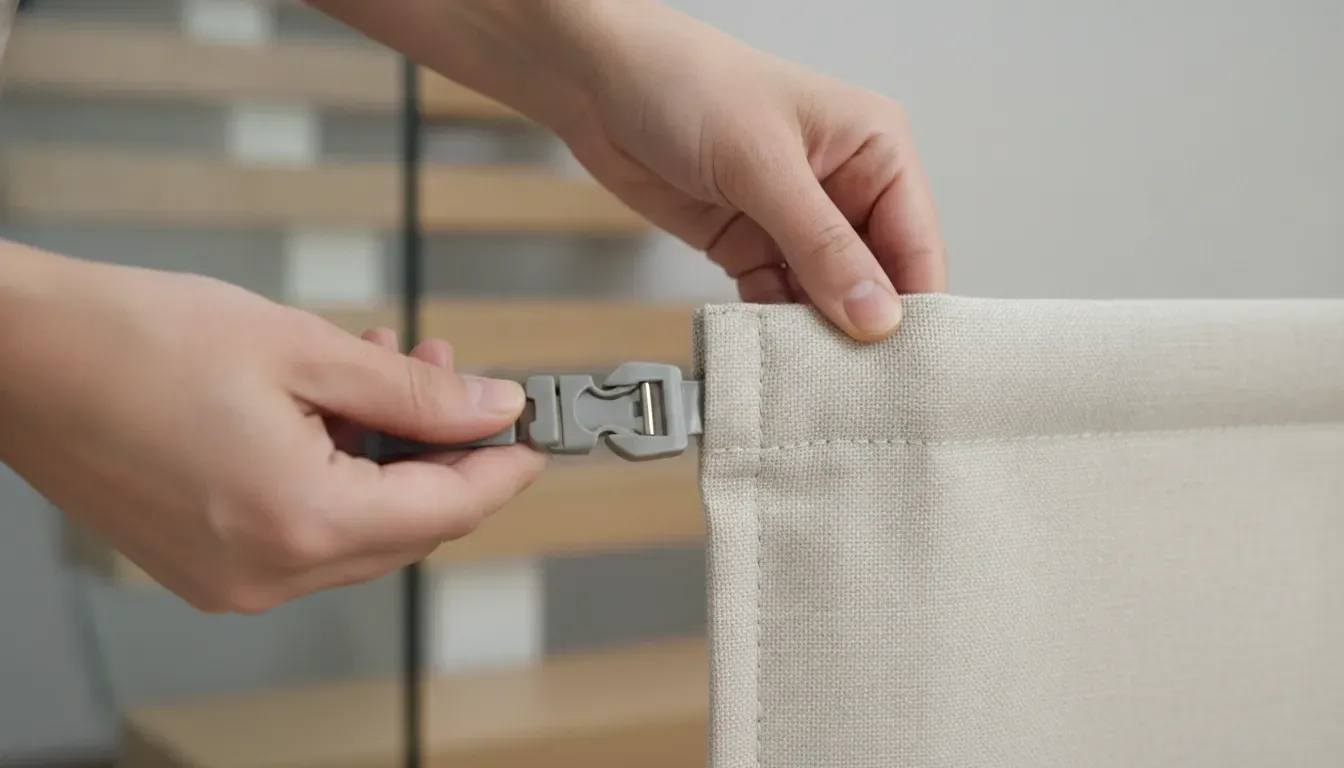
Buckles, latches, and release hardware
Closures should move as designed and stay secured during normal use. Check for cracked plastic, bent metal, loose stitching around a buckle, a release that sticks, or a latch that can be opened without the intended action. If a component is missing or the gate can be opened without following the instructions, do not rely on it while waiting for a replacement part.
Mounting points and surrounding surfaces
A strong barrier cannot compensate for a mounting point that has loosened or a surface that is no longer sound. Look for pulled screws, stripped holes, cracked trim, shifting banisters, damaged drywall, or a bracket that no longer sits flat. A wall-to-banister installation and a banister-to-banister installation have different attachment requirements, so follow the instructions for the exact configuration rather than transferring hardware from another setup.
Fit across the opening
Measure again if the gate has moved, the home has been renovated, or you are reinstalling it in a new location. The Stair Barrier's fit and sizing guide explains its two configurations and size ranges: Regular fits 36 inches to 43 inches, while Wide fits over 43 inches up to 52 inches. If the opening or mounting geometry is unusual, use the manufacturer's support process instead of guessing.
| Inspection result | Continue using? | Next step |
|---|---|---|
| Clean, intact barrier and secure closure. | Possibly, if fit and installation remain correct. | Continue routine inspections and follow the manual. |
| Loose hardware or shifting attachment point. | No, until corrected. | Stop use and follow the manufacturer's installation guidance. |
| Tear, frayed seam, crack, sharp edge, or missing part. | No. | Contact the manufacturer about an approved part or replace the gate. |
| Child can climb over, open, or defeat the gate. | Do not rely on it as the only barrier. | Reassess supervision, layout, and the appropriate safety solution. |
| Gate has been recalled or its history is unknown. | No until verified. | Check the manufacturer and recall information before use. |
See the Wall-to-Banister Stair Barrier for a wall-and-banister layout
When should you replace a baby gate?
Replace a baby gate when its condition, fit, or intended use can no longer be confirmed. Do not wait for a complete failure. A gate that is loose, damaged, missing a required component. Or unable to close and secure as designed should be removed from service until the manufacturer confirms an approved solution.
- The barrier has a tear, hole, frayed seam, stretched section, crack, sharp edge, or exposed broken component.
- The gate does not close, latch, buckle, or release consistently according to its instructions.
- Mounting hardware shifts, pulls away, no longer sits flat, or cannot be tightened using the approved method.
- The opening has changed and the gate no longer fits within its stated size range.
- A required installation piece, cap, strap, bracket, or instruction is missing and cannot be verified.
- The gate was involved in a fall, collision, severe impact, flood, or other event that may have stressed hidden components.
- The gate has been recalled, or you cannot identify its manufacturer and instructions well enough to confirm safe use.
- The child can climb over it, open it, or move it, especially where a fall from stairs is possible.
Some problems may be resolved with a genuine manufacturer-approved replacement part or a correctly performed reinstallation. Do not assume a universal part will fit. Ask the manufacturer whether the part is approved for your exact model and whether the rest of the gate should also be replaced.
When should you stop using a gate because of your child's development?
There is no single birthday that determines when every family should remove a baby gate. Continue to evaluate the child's abilities, the location of the gate, and the consequences of getting past it. Once a child can climb over, open, dislodge, or otherwise defeat the gate, it should not be treated as a reliable stand-alone boundary.
ASTM F1004-22 describes minimum safety performance requirements, test methods, and labeling and instructional requirements for expansion gates and expandable enclosures. The standard is useful context, but it is not a promise that a gate will work in every home or an expiration date for an individual product. Read the ASTM F1004-22 standard description, the manufacturer's instructions, and the gate's intended-use information together.
At stairs, the gate is an access-control product, not a replacement for a building-code guard, handrail, balustrade, or other permanent fall-protection feature. It also does not replace adult supervision. If your layout or the child's behavior creates a question that the product instructions do not answer. Pause use and seek guidance from the manufacturer or a qualified professional.
How can you help a baby gate last longer?
Good care can reduce avoidable wear, but it cannot make a damaged gate safe again. Use these habits to protect the gate and make inspections easier:
- Install the gate exactly as directed for the specific opening and mounting configuration.
- Keep the closure area clear of toys, blankets, cords, pet items, and other objects that could interfere with operation.
- Clean fabric and hardware only with the methods approved by the manufacturer.
- Dry washable fabric completely before reinstalling it.
- Do not hang items from the gate or use it as a handhold, pet perch, or storage rack.
- Recheck attachment points after moving furniture, changing flooring, or doing work near the staircase.
- Keep instructions and approved replacement-part information with the gate.
- When storing the gate, protect it from moisture, pests, crushing, and unapproved folding or bending.
For The Stair Barrier, the installation video and FAQ page shows the intended installation approach for banister-to-banister and wall-to-banister configurations. Use that resource alongside the supplied instructions, not as a substitute for checking your exact opening.
What should you look for in a replacement stair gate?
Replacement decisions should start with the opening and the use case, not with appearance alone. Confirm whether you need a banister-to-banister or wall-to-banister configuration, measure the opening, verify the mounting surfaces, and make sure the gate is intended for the location. For a stair installation, pay close attention to the supplied hardware and instructions.
Families comparing a new gate can also consider the material and care routine. The Stair Barrier is a fabric safety gate with machine-washable, dryer-safe fabric, roll-to-side storage, and upholstery-grade fabric options designed to blend into the home. Its product pages state that it meets ASTM F1004 safety standards. Those features may make daily care and home integration easier, but correct selection, installation, inspection, and supervision still matter.
Choose a fabric stair gate built for banister-to-banister openings
Frequently Asked Questions About Baby Gate Lifespan
How long do baby gates last on average?
There is no reliable universal number of years. A gate's useful life depends on construction, frequency of use, installation, exposure, maintenance, and condition. Replace it when it is damaged, unstable, recalled, missing parts, or no longer appropriate for the child or opening.
Is a five-year-old baby gate still safe?
Age alone does not answer the question. A five-year-old gate should be evaluated for its model history, instructions, recalls, material condition, closure, hardware, and fit. If you cannot verify those details, replacing it is a more responsible choice than guessing.
How often should I inspect a baby gate?
Look at the gate before use and perform a more complete inspection regularly, especially after an impact, move, cleaning, adjustment, or change to the surrounding staircase. Check the barrier, closure, mounting points, and opening together.
Should I replace a baby gate after moving?
Not automatically, but do not assume a gate that worked in one opening will work in another. Confirm the new opening, mounting surfaces, configuration, size range, hardware, and instructions before relying on it. A different staircase may require a different gate.
Are fabric baby gates durable?
Fabric gates can be durable when their fabric, seams, closures, and attachment system are designed for the intended use and cared for as instructed. Durability is not a guarantee of safe use. Inspect the fabric and hardware just as you would inspect a rigid gate's frame and latch.
Do I need a baby gate for a three-year-old?
Development and the location matter more than a fixed age. Consider whether the child can navigate the stairs safely, climb or open the gate, and understand the household rules. If the gate can be defeated, do not rely on it as the only control measure, and continue appropriate supervision.
The bottom line on baby gate lifespan
The safest answer to how long baby gates last is condition-based, not calendar-based. Inspect the entire system, verify the fit and installation, and replace the gate when damage. Instability, missing parts, a recall, or a change in the child's abilities makes reliable use uncertain. For a new stair gate, start with accurate measurements and the manufacturer's installation guidance. A well-designed barrier can support a safer home routine, but it works best when the product, opening, installation, inspection, and supervision all fit together.
For more help choosing a configuration, visit The Stair Barrier's buyers guide before ordering.

Written by Arden Vale
Design & Safety Specialist
Arden provides expert guidance on blending ASTM safety standards with modern interior styling, helping parents and pet owners create secure, beautiful spaces.