


A pet gate and a baby gate may look similar, but they are not always interchangeable. Pet gates are often designed around animal size and behavior. Baby gates must meet child-safety requirements. In a home with both pets and young children, choose a gate suitable for the most demanding user and the exact installation location.
Shop The Stair Barrier's fabric pet gates
Placement matters as much as purpose. A doorway, hallway, and staircase each create different fit and installation needs. This guide compares pet gates and baby gates. It explains what to check before buying and helps you choose an attractive barrier that supports safer routines without taking over your decor.
Pet gate vs baby gate: the key differences
The key difference is the intended user. A baby gate is designed and tested for young children, while a pet gate may focus on an animal's height, size, or habits. The Stair Barrier offers fabric safety gates that meet ASTM F1004 standards and can serve families with children, pets, or both when properly selected and installed.
Purpose and safety standards
Baby gates sold in the United States must comply with the federal safety standard for gates and enclosures, which incorporates ASTM F1004. The standard addresses issues such as structural integrity, latching, openings, and entrapment risks. A product marketed only as a pet gate may not be tested to the same child-safety standard.
If a child will ever be near the barrier, use a gate intended for children and follow its instructions. A pet-only label does not establish child safety. For pet-only households, the animal's size, jumping ability, chewing behavior, and temperament remain important considerations.
Materials and everyday design
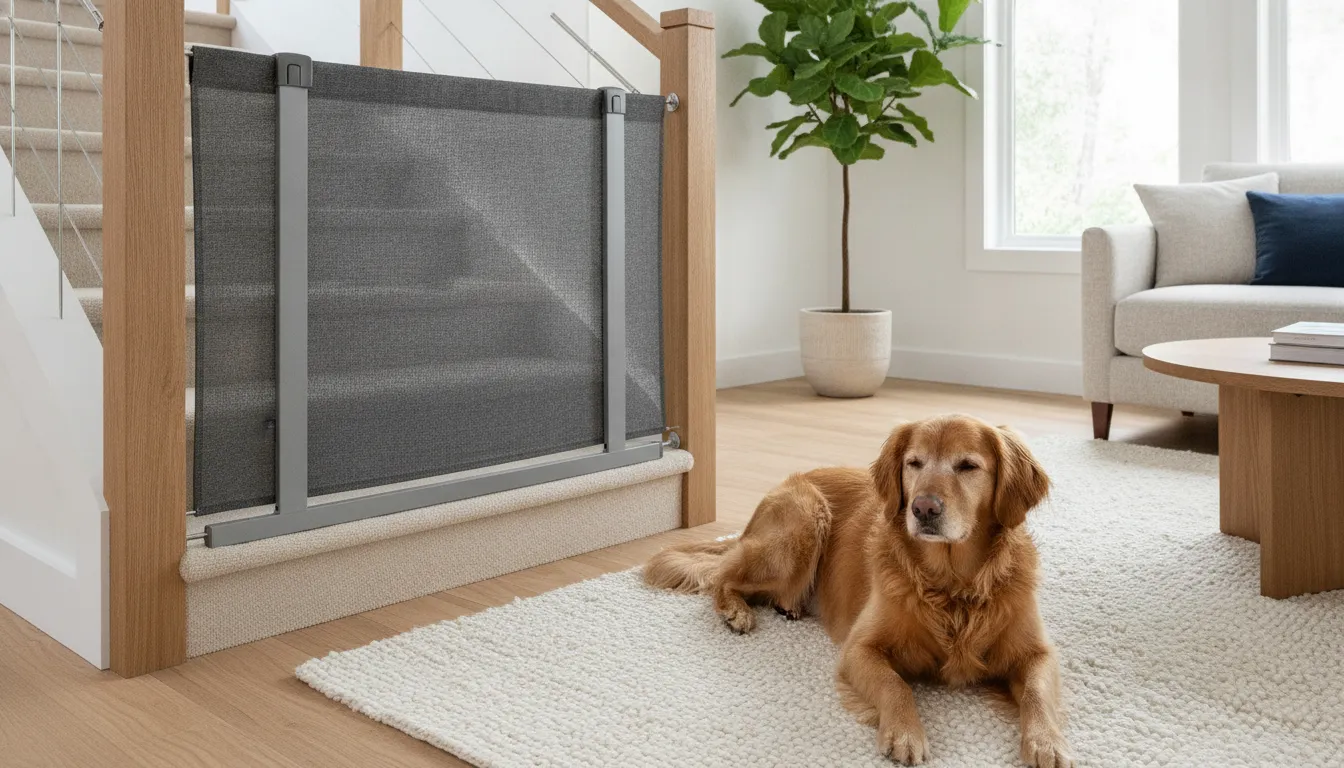
Both product categories can include metal, plastic, wood, mesh, or fabric. The material affects how the barrier looks, stores, and cleans. A rigid swing gate may need clearance around the opening. A fabric barrier can roll neatly to the side when not in use and feels less visually bulky in a carefully designed room.
| Feature | Baby gate | Pet gate |
|---|---|---|
| Primary user | Infant or toddler | Dog, cat, or other pet |
| Safety standard | Must meet applicable child-gate requirements | Requirements vary by product |
| Key selection concern | Child safety, placement, and fit | Pet size, behavior, placement, and fit |
| Shared-home choice | Choose a child-suitable gate that also fits the pet and location | |
What should you look for in a pet gate?
A useful pet gate fits the opening, suits the animal's behavior, and works with daily household traffic. The Stair Barrier's fabric designs add machine-washable, dryer-safe construction and roll-to-side storage. Those features are practical for pet owners, but correct measurement and realistic expectations about the pet remain essential.
Match the barrier to your pet
Start with the animal, not the product label. A calm small dog creates different demands than a large dog that jumps, pushes, or chews. Cats and athletic dogs may climb or clear barriers that work well for other pets. No gate can stop every animal, and a barrier does not replace supervision or training.
- Size: Consider the pet's height, weight, and ability to squeeze through openings.
- Behavior: Account for jumping, climbing, chewing, pawing, and pushing.
- Temperament: Watch how the pet responds to separation and new boundaries.
- Location: Identify whether the barrier belongs in a doorway, hallway, or stair opening.
Check fit and daily usability
Measure the opening rather than guessing. Check the width at the relevant attachment points and identify whether the sides are walls, banisters, or one of each. For unusual openings, use The Stair Barrier's measuring guidance or request photo-based support before ordering.
Also consider how often people pass through the space. If the barrier is opened frequently, roll-to-side storage can keep the route clearer when the gate is not needed. Washable fabric is useful where muddy paws, shedding, and everyday spills are likely.
What makes a baby gate different?
A baby gate is built around predictable child-safety requirements, not simply the ability to block an opening. The Stair Barrier meets ASTM F1004 safety standards, but families must still choose the correct configuration, measure carefully, install it as directed, and supervise children. No gate eliminates every household risk.
Child-safety testing matters
ASTM F1004 addresses performance and design requirements for expansion gates and expandable enclosures. It helps reduce risks related to gate failure, hazardous openings, and other foreseeable issues. That makes standards compliance a meaningful distinction when comparing an untested pet-only barrier with a gate intended for young children.
Do not assume that a tall or heavy pet gate is automatically suitable for a baby. Height and weight alone do not confirm child-safety performance. Check the manufacturer's stated use and instructions for the specific product.
Placement changes the choice
Stair openings deserve special attention because a failed or poorly placed gate can create a fall hazard. Pressure-mounted models rely on force against surrounding surfaces and should not be assumed safe for stairs. Choose a product specifically intended for the location and follow every installation instruction.
The Stair Barrier has dedicated configurations for common stair setups. A Banister-to-Banister fabric safety gate fits openings with posts on both sides. A Wall-to-Banister fabric safety gate is designed for a wall on one side and a banister on the other.
Can one gate work for pets and children?
Yes, one gate can serve both pets and children when it is suitable for children, appropriate for the pet, correctly fitted, and installed in an approved location. The Stair Barrier is designed as a fabric safety gate for family homes and meets ASTM F1004 standards. Always select for the more demanding use.
Choose for the highest safety need
If a young child lives in or regularly visits the home, begin with a child-suitable gate. Then evaluate whether that same gate can manage the pet's height and habits. A calm dog may respect a barrier immediately, while an energetic jumper or persistent chewer may need a different management plan.
The same principle applies in reverse. A pet gate that controls a dog is not necessarily appropriate for a toddler. Confirm standards, intended use, fit range, and placement before relying on one product for both.
Build a complete safety routine
A gate is one part of a safer household routine. Check the installation regularly, keep latches and attachment points in good condition, and supervise children and pets near stairs. Help a pet learn the new boundary gradually rather than assuming the barrier will solve every behavior issue.
Compare fabric safety gates for children and pets
How do you choose the right gate for your home?
The right choice begins with the user, the location, and exact measurements. The Stair Barrier offers over 20 upholstery-grade fabric options, so design can be part of the decision after the safety and fit requirements are clear. Use this process to narrow the options without guessing.
- Identify every user. Note whether the barrier must serve pets, children, or both.
- Assess behavior. Consider jumping, climbing, chewing, pushing, and how the pet reacts to separation.
- Choose the location. Decide whether the gate belongs at stairs, in a doorway, or across a hallway.
- Identify the surfaces. Confirm whether the opening has two walls, two banisters, or one of each.
- Measure carefully. Follow the maker's measuring instructions and ask for support when the fit is uncertain.
- Confirm intended use. Check the safety standard, approved placements, and installation directions.
- Plan for daily life. Consider traffic flow, storage, cleaning, and how the gate fits the room.
Compare the available configurations
For a staircase with banisters on both sides, review the banister-to-banister options. For a wall on one side and a post on the other, explore the wall-to-banister collection. For other opening types, check the complete product details and request fit support rather than improvising an installation.
Consider the home's design
Safety equipment does not have to look temporary or industrial. The Stair Barrier uses upholstery-grade fabric in a wide range of colors and patterns, allowing the gate to coordinate with the room. Its lightweight fabric construction rolls to the side and can be machine washed and dried when needed.
Why does stair placement change the decision?
Stairs increase the consequences of a poor fit or unsuitable installation. The Stair Barrier was created for challenging stair configurations, including banister-to-banister and wall-to-banister openings. Select the configuration designed for your surfaces, follow the instructions, and never treat a doorway solution as automatically appropriate for stairs.
Stair openings are not standard doorways
Doorways often provide two flat, parallel walls. Stair openings may include rounded posts, decorative banisters, baseboards, or uneven attachment points. Those details affect where and how a gate can be secured. Measuring only the narrowest visible gap may not provide enough information for a reliable fit.
For this reason, use the product's measuring process and installation resources. If the opening is unusual, photos can help the support team recommend the appropriate path. Avoid drilling, strapping, or adapting a gate in a way that conflicts with its instructions.
Clear storage supports daily use
A bulky open gate can interfere with stair traffic. The Stair Barrier rolls to the side when not in use, which helps keep the route visually and physically clearer. It is also lightweight and portable, useful for families who need a familiar barrier at a second home or when visiting grandparents.
Frequently asked questions about pet gates
Can a baby gate be used as a pet gate?
Often, yes. A child-suitable gate may also work as a pet gate if it fits the opening and can manage the animal's size and behavior. Check the manufacturer's intended use, watch for jumping or chewing, and never assume one barrier will work for every pet.
Can a pet gate be used for a baby?
Only when the gate is specifically suitable for children and meets applicable child-safety requirements. A pet-only gate may not meet the same standards. Check the product's stated use and instructions before using it around a baby or toddler.
Are pressure-mounted gates appropriate for stairs?
Do not assume a pressure-mounted gate is appropriate for stairs. Stair placement requires a product intended for that specific location and a secure installation according to the manufacturer's directions. Review the approved placement before buying or installing any gate.
How should I measure for a pet gate?
Identify the attachment surfaces first, then measure the opening at the points specified by the manufacturer. Stair banisters and walls can create uneven widths. Use The Stair Barrier's measuring guide or send photos for support if you are unsure which configuration fits.
Will a pet gate stop every dog or cat?
No. Athletic, determined, anxious, or chewing pets may defeat a barrier that works for other animals. Choose for the individual pet, introduce the boundary gradually, inspect the gate regularly, and supervise as needed. A pet gate supports responsible management but does not replace it.
Find a pet gate that fits your family and home
A shared home does not need separate barriers simply because it includes both pets and children. Start with child-safety suitability when children are present, then confirm the gate fits the pet, opening, and daily routine. The Stair Barrier combines ASTM F1004 compliance with washable fabric, roll-to-side storage, and design-conscious options.
Measure carefully and select the configuration intended for your space. If your staircase is unusual, use the available measuring resources or request photo-based support before ordering.
Find your fabric pet gate from The Stair Barrier

Written by Arden Vale
Design & Safety Specialist
Arden provides expert guidance on blending ASTM safety standards with modern interior styling, helping parents and pet owners create secure, beautiful spaces.