


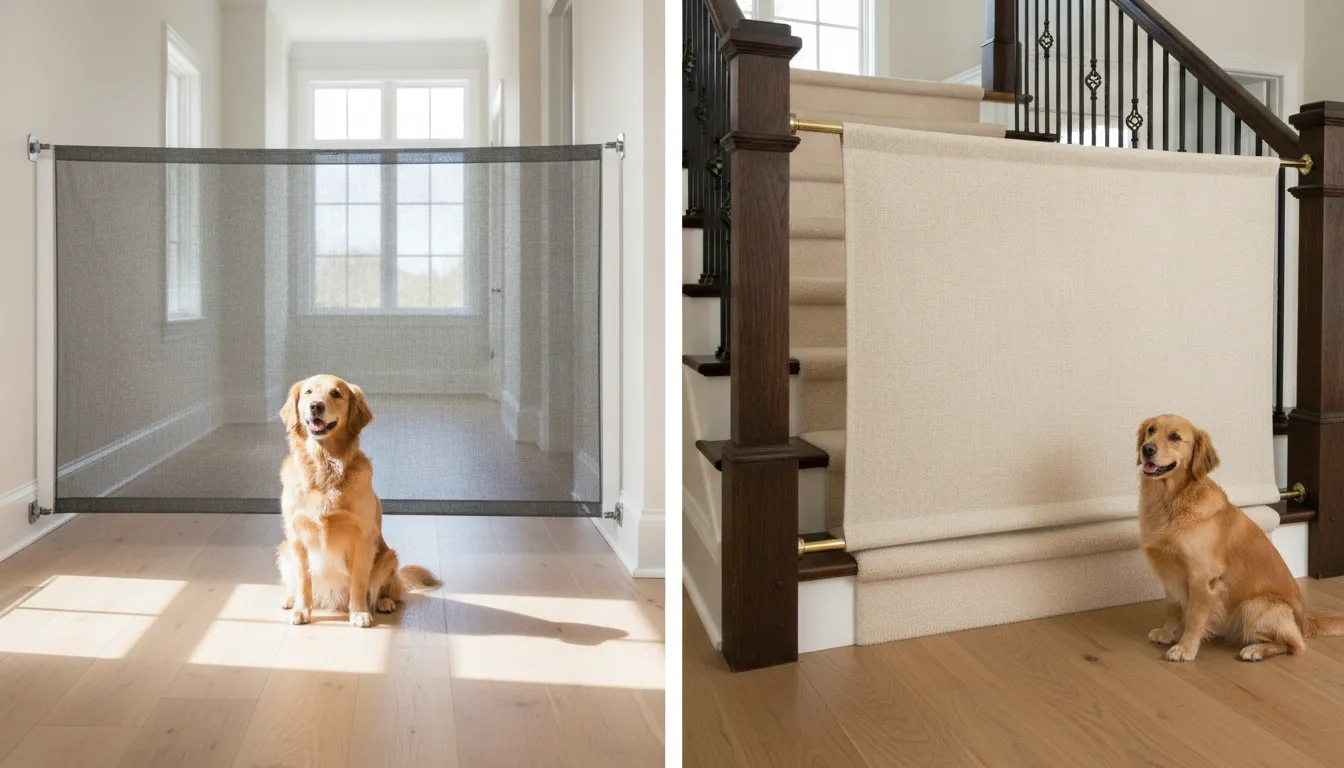
A retractable dog gate saves space by pulling a flexible mesh panel across an opening and rolling it back into a housing when the path needs to be clear. A fabric stair barrier offers a softer, design-focused alternative that can suit banisters and unusual stair openings. The best choice depends on your dog's behavior, the location, the mounting surface, and how you use the space each day.
Explore stylish fabric safety gates for your home.
Retractable dog gate vs. fabric stair barrier at a glance
Both options avoid the visual weight and swing radius of a traditional metal gate, but they work differently. A retractable dog gate rolls mesh into a fixed case. A fabric barrier uses a substantial fabric panel that can roll to the side, attach around banisters, and become part of a room's design.
| Feature | Retractable dog gate | Fabric stair barrier |
|---|---|---|
| Barrier material | Flexible mesh | Upholstery-grade fabric |
| Open position | Rolls into a mounted case | Rolls neatly to one side |
| Typical attachment | Hardware fixed to flat surfaces | Straps for banisters or hardware for walls |
| Cleaning | Usually wiped clean | Fabric can be machine washed and dried |
| Visual effect | Minimal when retracted | Decorative while closed |
| Best fit | Compatible doorways and hallways | Stair openings, including banister configurations |
A gate is only useful when it fits correctly and matches the behavior of the pet it is intended to guide. A calm dog that respects boundaries has different needs from a determined jumper, chewer, or digger. If children also live in or visit the home, choose a gate that is intended for child safety and meets ASTM F1004. No gate eliminates risk or replaces attentive adult supervision.
How does a retractable dog gate work?
A retractable dog gate uses a flexible mesh panel wound around a spring-loaded roller inside a vertical housing. An adult pulls the panel across the opening, connects it to catches on the opposite side, and activates the lock. When released, the panel rolls back into its housing to clear the walkway.
This design is popular in narrow halls and busy doorways because there is no rigid gate panel swinging into the room. It can also remove the need to lift and store a freestanding barrier whenever the opening is not being restricted. The case and catches remain visible, but the flexible panel largely disappears while open.
Mounting and tension
The housing and catches generally require firm attachment to compatible walls, trim, or posts. Correct alignment matters because the mesh relies on tension to remain in position. If the sides are mounted at different heights, the panel may not close smoothly or may leave a gap. Baseboards, angled walls, and rounded banisters can complicate an otherwise simple installation.
A retractable panel is flexible by design. That does not automatically make it suitable for every dog. A dog that paws at mesh, tries to crawl under barriers, or rushes toward distractions may test the panel and mounting points repeatedly. Follow the maker's size, placement, and use restrictions instead of assuming a gate will contain any pet.
Locks and everyday passage
Most designs include a lock that controls the roller or helps keep the panel extended. Adults must use that lock every time they close the gate. A panel that appears shut but is not latched can create false confidence. Everyone in the household should know how to close, lock, and check it before leaving the opening.
Retracting the panel keeps the walkway clear, which can be helpful when carrying groceries or moving between rooms. It may retract quickly, however, so guide it back according to the instructions rather than letting it snap into the case. Routine, careful use protects both the mechanism and nearby people or pets.
What makes a fabric stair barrier different?
A fabric stair barrier replaces thin retractable mesh or rigid bars with a substantial fabric panel designed for stair openings. Depending on the model, it can attach banister-to-banister, wall-to-banister, or wall-to-wall. Its panel rolls to the side when open and can complement the room rather than looking purely utilitarian.
The Stair Barrier is a premium fabric safety gate created for homes where safety and aesthetics both matter. Its upholstery-grade fabric options let owners coordinate a barrier with rugs, furniture, and finishes. The solid panel also offers a softer visual presence than plastic or metal bars. See the banister-to-banister fabric safety gate.
Flexible fit for banisters
Banisters often make stair-gate shopping difficult. Posts may be round, square, tapered, carved, or positioned at an angle. A banister-to-banister fabric model uses straps around the posts, avoiding the need to drill into valued woodwork. Wall-to-banister and wall-to-wall layouts use the appropriate wall-side hardware while keeping a coordinated fabric panel across the opening.
This flexibility does not mean fit can be guessed. The opening still needs to fall within the selected model's specifications, and every attachment must be installed as directed. Measure the exact location and use photo-based support when posts, walls, baseboards, or angles make the choice unclear.
Washable, portable, and design conscious
Dogs bring fur, muddy noses, and occasional messes into daily life. A removable panel that is machine washable and dryer safe can be easier to refresh than a mesh screen with a fixed roller. Fabric barriers are also lightweight and portable, making them practical for families that need to move or travel with a familiar boundary.
The fabric construction supports the brand idea that Safe Never Looked So Good. Owners can choose from more than 20 upholstery-grade fabric options instead of settling for a generic finish. When the barrier is not needed, it rolls neatly to one side without occupying the floor or requiring a separate storage closet.
Which gate suits your dog and your space?
Choose a gate by evaluating your dog's size, jumping or chewing habits, the opening's shape, the approved installation location, and the surfaces available for mounting. A retractable dog gate can suit a compatible hallway and a calm pet. A fabric stair barrier can better serve design-focused homes with banisters or unusual stair openings.
Start with your dog's behavior
Size is only one consideration. A small, determined dog can dig, squeeze, or chew more persistently than a calm large dog. Watch how your dog responds to existing boundaries. If the dog repeatedly jumps, charges, or works at the bottom edge, do not assume a soft gate will change that behavior without training and supervision.
A solid fabric panel limits the view through the barrier, which may help reduce visual triggers for some dogs. Mesh lets light and sightlines pass through, which may be preferable in other rooms. Neither material is guaranteed to stop barking, climbing, or escape attempts, so match the product to observed behavior and the manufacturer's guidance.
Consider how people move through the area
A gate that is difficult to operate may be left open. Think about who uses the path, how often they pass, and whether they frequently carry a child, laundry, or supplies. Both retractable and roll-to-side fabric options keep the floor clear when open, but their latches, closing motions, and mounting points feel different in daily use.
Also consider visitors and grandparents who may not know the system. A simple household routine can help: close it, engage every required latch, and check the edges before walking away. Never allow children to climb or play on a gate, and do not rely on a pet barrier as child protection unless it is specifically intended and tested for that use.
Respect the opening and mounting surface
Flat walls and square trim can support many gate styles. Curved banisters, decorative posts, thick baseboards, and angled openings narrow the choices. A retractable housing normally needs a stable vertical mounting area, while a fabric barrier offers models made for different combinations of walls and banisters.
At stairs, avoid pressure-mounted gates, especially at the top, because a pressure fit can slip. Use a solution approved for the exact placement and install it according to its instructions. For more context, review these tips for keeping dogs off the stairs.
How should you measure before choosing a gate?
Measure the intended opening at the exact height and attachment points where the gate will sit, not just across the floor. Record widths at multiple heights, note baseboards and trim, identify whether each side is a wall or banister, and photograph unusual posts or angles. Compare those details with the product's approved fit range.
Use a repeatable measuring process
- Clear the area so the walls, floor, trim, and posts are easy to see.
- Identify the precise mounting point on each side of the opening.
- Measure across the opening at the bottom, middle, and planned top of the barrier.
- Record the narrowest and widest measurements rather than rounding them.
- Note baseboard depth, wall molding, post shape, and any angle between sides.
- Take clear front and side photos if anything about the opening is unusual.
Do not select a gate solely from the width of a nearby doorway or from a previous gate's label. Small differences in mounting height can change the usable width, especially around tapered banisters. Exact measurements make it easier to identify the appropriate model and avoid gaps, strain, or incompatible hardware.
Ask for fit guidance instead of guessing
If your staircase includes curved posts, offset walls, thick trim, or an unusual landing, use the brand's measuring guidance or photo-based support before ordering. A fit check can clarify whether you need a banister-to-banister, wall-to-banister, or wall-to-wall configuration and which attachment approach makes sense.
After installation, check the full perimeter and all connections. Recheck them regularly because repeated opening, closing, and contact can loosen components over time. Stop using the gate if hardware, straps, fabric, mesh, latches, or mounting surfaces show damage or no longer hold as intended.
Daily use, cleaning, and design considerations
Daily satisfaction often depends on details that are easy to overlook while shopping. Consider how the gate sounds, how it opens, how it looks while closed, and how it will be cleaned. The ideal barrier is one adults can operate correctly every time without creating a frustrating obstacle in the home.
Cleaning and maintenance
A retractable dog gate usually needs spot cleaning or wiping because its mesh remains connected to the roller assembly. Keep moisture and cleaning products away from the mechanism unless the instructions say otherwise. Inspect the mesh edges, housing, catches, and lock for wear, and confirm that the panel still extends and retracts smoothly.
A removable fabric panel offers a different care routine. The Stair Barrier's fabric is machine washable and dryer safe, helping owners handle pet hair, muddy marks, and everyday household messes. Follow all product care instructions and inspect straps, buckles, wall hardware, and fabric before reinstalling the clean panel.
Appearance while open and closed
Retractable gates are visually minimal when open because the mesh rolls into the housing. When closed, the screen tends to look simple and functional. A fabric barrier remains more noticeable while closed, but its colors and patterns allow that visibility to feel intentional. Explore how to prepare when bringing home a puppy.
Choose based on the gate's closed appearance, not only how well it disappears. A barrier may remain closed for hours each day. Furniture-grade fabric can blend with a curated interior, while an understated mesh screen may work well in a casual hallway. The best visual choice is the one you will use consistently and correctly.
Safety remains an ongoing routine
Whether you select mesh or fabric, read the instructions before installation and keep them for future reference. Confirm that the model is approved for its intended location and user. Check every connection after installation, then inspect the system regularly. Replace damaged parts only as directed by the manufacturer.
The Stair Barrier meets ASTM F1004 safety standards, but no safety gate eliminates every risk. Gates do not replace adult supervision, thoughtful pet training, or careful movement around stairs. Keep pets and children from climbing, hanging, or playing on any barrier, and address a loose or damaged gate immediately.
Frequently Asked Questions
Are retractable dog gates safe for large dogs?
A retractable dog gate may work for a calm large dog if the manufacturer rates it for the dog's size and the gate is securely installed. It may not suit a dog that jumps, charges, digs, or chews. Check the product instructions, inspect it regularly, and supervise your dog.
Can retractable dog gates be used on stairs?
Only use a retractable dog gate on stairs when its manufacturer specifically approves that placement and the installation follows every instruction. Stair openings require secure mounting and careful fit. Avoid relying on a pressure-mounted gate at the top of stairs, and never treat any gate as a substitute for supervision.
What can I use instead of a dog gate?
Alternatives include a fabric stair barrier, a hardware-mounted gate, a closed door, a pet pen, or a supervised room arrangement. The right option depends on the opening, the dog's behavior, and whether children also use the space. For stairs, choose a solution designed and fitted for that exact location.
Do they make retractable pet gates for exterior stairs?
Some manufacturers offer retractable pet gates rated for outdoor use, but not every retractable gate can handle exterior conditions or stair placement. Confirm the product's approved locations, weather resistance, mounting requirements, and size limits. Inspect outdoor hardware often, because moisture, temperature changes, and sun exposure can affect performance.
Make safety fit your home
A retractable dog gate is useful when a compatible opening needs a barrier that nearly disappears while open. A fabric stair barrier is a strong alternative when you want upholstery-grade style, washable material, lightweight portability, and installation options suited to banisters. Whichever design you choose, accurate measuring, approved placement, correct installation, regular checks, and supervision matter most.
Find a fabric safety gate that complements your home.

Written by Arden Vale
Design & Safety Specialist
Arden provides expert guidance on blending ASTM safety standards with modern interior styling, helping parents and pet owners create secure, beautiful spaces.