


Standard baby gates often require drilling heavy hardware into the finished wood of a staircase banister. These permanent scars are a significant concern for homeowners who value their interior design. A properly designed safety system secures the opening without damaging your woodwork.
Find your baby gate for banisters with The Stair Barrier's fit guide.
A baby gate for banisters must provide a secure fit without compromising the structural integrity or finish of your staircase. Improperly installed gates are a leading cause of stair-related injuries in young children, making a reliable mounting system essential for home safety. According to the National Library of Medicine, children under two are at the highest risk for falls if a safety barrier collapses or fails. To prevent these accidents while protecting your woodwork, homeowners should look for fabric safety gates or universal mounting kits. These solutions use specialized straps to attach to banister posts without the need for drilling. This approach supports ASTM F1004 safety standards while remaining easy to remove or store. By choosing a specialized barrier, you can maintain a beautiful home while improving stair access control.
Selecting the correct safety solution requires understanding the unique geometry of your staircase. Stairways involve complex angles and varied banister shapes that require specialized mounting hardware. That starts with understanding what makes stair openings different from standard doorways.
Baby gate for banisters: what makes stair openings different
Unlike standard hallways or doorways, staircases present unique mounting hurdles. Hallways usually have flat, parallel walls. In contrast, many staircases feature banisters on one or both sides. These banister posts can be round, square, or tapered. This makes finding a secure fit for a standard gate difficult. You face uneven surfaces that do not support traditional mounting hardware.
Geometric challenges of banister posts
Banister posts, also called newel posts, come in many shapes and sizes. Some are perfectly round, while others have decorative grooves or tapering. These shapes create gaps when you try to use a flat-surfaced gate. If the gate does not sit flush against the post, it may wobble or shift. This is why many parents look for stair gates for difficult stairs that can adapt to these odd shapes.
You must also consider baseboards or moldings that might block a clean installation. Banisters are not always aligned directly across from each other. This misalignment means a gate must be able to pull at an angle to close the gap. Traditional wood or metal gates rarely offer this level of flexibility.
The danger of pressure-mounted gates on stairs
Many parents assume a pressure-mounted gate will work for banisters. But pressure gates rely on two flat walls to stay in place. Banisters lack the surface area needed for these gates to grip safely. According to research on pediatric stair injuries, gate failure is a leading cause of falls for children under two years old. Pressure gates can slip or collapse if a child leans or pulls on them.
For this reason, safety experts recommend against using pressure-mounted gates at the top of a staircase. A secure connection to the post is vital to prevent the gate from giving way. Hardware-mounted solutions or specialized banister kits provide a higher level of stability for active toddlers.
Managing uneven stair landings
Stair landings have trim or decorative woodwork that creates uneven depths. A standard gate requires a flat plane for mounting. If your stairs have a banister on one side and a wall on the other, the heights may not match. You might find that the drywall is recessed compared to the wooden post. These differences can lead to a crooked gate that does not lock properly. You should use how to measure your staircase guides to account for these specific height and width variations. Knowing the specific size of your banisters is the first step toward a safe home.
Understanding ASTM F1004 safety standards
When you shop for a baby gate for banisters, check for safety certifications. ASTM F1004 is the consumer safety specification for expansion gates and expandable enclosures. It helps show that a gate has been tested for relevant strength and stability requirements. The Stair Barrier meets ASTM F1004 safety standards, while still requiring correct installation and adult supervision.
Can you install a baby gate on a banister without drilling?
Yes, you can install a safety gate on your stairs without drilling into your woodwork. Many homeowners worry about damaging expensive banisters or new wood finishes. You can protect your home and keep your child safe by using the right mounting method. Specialized designs allow you to secure a gate using straps or banister-mount kits that grip the posts instead of piercing them.
Protecting your home woodwork
Traditional baby gates often require you to screw heavy hardware directly into your staircase. This can leave permanent holes in fine wood or decorative banisters. If you live in a rental home, you might even lose your security deposit for making such changes. A fabric safety gate for banisters offers a better way to handle these tricky areas. These gates use heavy-duty straps to wrap around the banister posts, keeping the wood safe from damage.
The Stair Barrier uses handcrafted, upholstery-grade fabrics that look like part of your home decor. These materials are not just attractive; they are also durable. You can wash them in your machine and dry them when they get dirty. This style and function mix makes it a strong choice for parents who want a safe, curated home. You do not have to choose between a secure gate and a beautiful entryway.
Why pressure-mounted gates are risky
Many parents first think of pressure-mounted gates when they want to avoid drilling. While these can be useful for some doorways, they are often not the safest choice for stairs. Pressure-mounted gates rely on tension to stay in place. On a banister, these gates can easily slip or feel loose if a child leans on them. In some cases, the gate can collapse, which creates a fall risk.
Research shows that gate failure is a leading cause of stair-related injuries for children under two years old. One study found that many stairway injuries happen after a gate collapses or a child manages to push through it. Because banister posts can be round or odd-shaped, getting a firm grip with a standard pressure gate is difficult. A dedicated hardware-mounted or strap-based system is much more reliable for these high-traffic areas.
Finding the right fit for your stairs
To ensure a secure fit, first determine if you need a banister-to-banister or wall-to-banister gate. Each setup uses different hardware to stay in place without drilling into the banister. For example, a wall-to-banister gate might use hardware on the wall side, while the banister side uses a no-drill kit. You should always check the diameter and shape of your posts to make sure the mounting kit is compatible. Using the wrong hardware can make even the best gate feel shaky.
Before you buy, it is helpful to look at how to measure your staircase properly. Getting the right width ensures the gate fits snugly between your banisters. If your opening is too wide or too narrow, the straps may not wrap correctly around the posts. You can also watch installation resources to see exactly how the no-drill process works. These tools help you feel confident that your gate is secure without guessing.
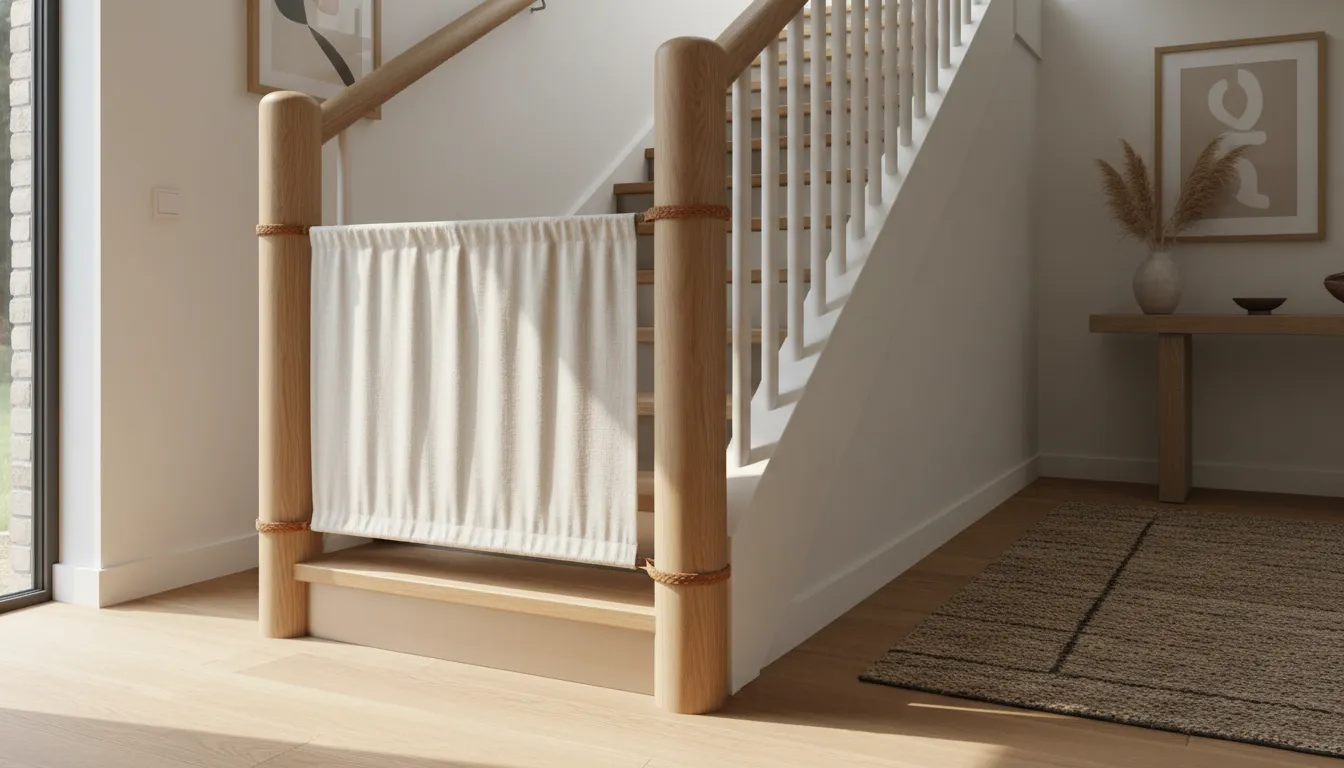
Compare banister baby gate options before you buy
The best baby gate for banisters is the one that matches your stair layout, protects the banister finish, and can be installed according to the manufacturer's instructions. A gate that works beautifully in a straight hallway may not be the right fit at a stair opening with two rounded posts. A decorative newel, or a wall on only one side.
Before you choose, look at the installation surface first. If you have banisters on both sides, a banister-to-banister design is usually the cleanest path. If one side is a wall and the other is a banister, look for a wall-to-banister configuration. If the railing area also has wide gaps between spindles, you may need a separate guard or shield in addition to the gate.
| Option | Best for | What to watch |
|---|---|---|
| Fabric safety gate | Design-conscious homes, banister-to-banister openings, wall-to-banister openings, and parents who want a softer look | Measure carefully and use the correct configuration for your opening |
| Hardware-mounted wood or metal gate | Stair tops where the product is rated for that use and solid mounting points are available | May require drilling into woodwork or adding adapter kits |
| Pressure-mounted gate | Some doorways or lower-risk pass-through spaces, depending on product directions | Do not assume it is appropriate for stairs or banisters |
| Banister shield or net | Reducing access through railing gaps | Not a full substitute for a stair gate that manages access to steps |
The Stair Barrier is built around the banister problem. Its fabric safety gates are made for stair openings that do not behave like standard doorways, including banister-to-banister and wall-to-banister layouts. The fabric construction also changes how the gate feels in the room. Instead of a bulky plastic or metal panel becoming the first thing you see, the barrier can coordinate with the home.
That design advantage matters because a stair gate often stays up through a long stage of family life. The Stair Barrier offers more than 20 upholstery-grade fabric options, and the fabric is machine-washable and dryer-safe. The gate can roll to the side when not in use, which helps keep the stairway looking intentional rather than cluttered.
Whatever option you choose, avoid improvised fixes. A stair gate should not depend on a guess, a loose strap, or a tension-only setup that the manufacturer has not approved for the location. If the opening is unusual, measure it, photograph it, and use the brand's support resources before buying.
Shop banister-to-banister Stair Barriers when both sides of your opening are posts.
How to measure for a banister-to-banister or wall-to-banister fit
Correct measurements make sure your baby gate for banisters stays secure. A gate that does not fit can fail if a child leans on it. Research from the National Institutes of Health shows that gate collapse is a top cause of stair falls. Take the time to measure well. Doing so keeps your safety barrier in place.
Identify your staircase configuration
First, look at your stairs to see where the gate will go. A banister-to-banister setup has posts on both sides. Other layouts have a flat wall on one side and a post on the other. This is a wall-to-banister setup. You can read more about how to measure your staircase to pick the best fit. Knowing your layout helps you choose the right model.
Measuring the opening width correctly
Use a metal tape measure for the space between your mounting points. For a banister-to-banister fit, measure from the inside of one post to the other. Measuring from the wall to the post works for other setups. Always measure at the top and bottom. Opening widths can change from floor to rail. A fabric safety gate for banisters gives you room while keeping a tight seal.
Inspecting your mounting points
Check the shape and size of your posts before you buy. Some posts are round, while others are square. You need a clear place on the post for the straps to wrap around. If your posts are thick, you might need a special kit. Make sure the wall side of a setup is solid. It should not be blocked by wood trim. A clear path for the gate makes sure it latches well every time.
- Identify the layout: Find out if your stairs need a banister-to-banister or a wall-to-banister gate model.
- Measure the opening: Measure the width of the opening from the inside of the posts or the wall surface.
- Check both heights: Take measurements at the floor level and the top height where the gate will sit.
- Inspect post shape: Look at the shape and size of your banister posts to make sure the straps fit.
- Note trim or molding: Check for trim on the wall side that might stop the gate from being flush.
- Photograph tricky angles: Take a clear photo of your stairs if you have a tricky layout or odd banister shape.
- Confirm before ordering: Read the official measuring guide or ask for help with hard setups.
Do not guess if you are not sure about your measurements. A small mistake can lead to a gate that is too loose to latch. You can find more measuring guidance on the website. Clear photos of your stairs also help the team give you the best advice.
How do you attach a baby gate to a round banister?
Round banisters often make parents worry about the strength of a safety gate. Standard hardware usually needs a flat surface to stay secure. When you try to mount a gate to a curved post, it may shift or slip over time. This lack of stability is a real safety concern.
Gate collapse is a leading cause of stair-related injuries for children under two years old. You need a solution that stays firm without damaging your home.
Specific mounting kits
The best way to secure a gate to a round post is with a banister-mount kit. These kits use heavy-duty straps or clamps that wrap around the wood. This creates a solid anchor point without the need for drilling. A high-quality kit will adjust to the specific width of your post.
It also protects your home's design from scratches or long-term holes. You can find detailed banister-to-banister installation instructions that explain how these kits work.
Using a baby gate for banisters ensures the barrier stays in place even if a child leans on it. The straps pull the mounting plate tight against the round surface. This creates a flat area for the gate to connect to.
This method is much safer than trying to screw hardware directly into a curved post. It also allows the gate to stay level across the entire opening.
Makeshift installation risks
It might be tempting to use zip ties or extra tape to secure a standard gate. These makeshift fixes often fail because they cannot handle the weight of a growing toddler. Plastic ties can snap under pressure. Tape also loses its grip over time as the gate moves.
You should also avoid using pressure-mounted gates on stairs. These gates rely on tension alone to stay in place. They can slide off a round banister if they are bumped or pushed. This creates a serious fall hazard at the top of your staircase.
A dedicated banister kit provides a strong link that tension alone cannot match. It stays firm through daily use and resists shifting. It also allows you to remove the gate easily when you no longer need it. This keeps your woodwork looking brand new for years to come.
Manufacturer installation guides
Each staircase is different. Before you buy a kit, measure the width of your round posts. Most kits list the specific sizes they are made to fit.
You should also watch installation resources to see the process in action. Seeing the steps can help you choose the right tools for your specific home layout. Following these guides supports a secure, attractive barrier. It also helps you avoid guessing at a stair opening where precision matters.
How to baby proof the rest of the banister area
To baby proof the banister area, combine a properly fitted stair gate with checks for spindle gaps, climbable objects, latch habits, and regular installation inspections.
A gate controls access to the stairs, but the banister area around the gate deserves its own safety check. Look at the railing from a child's point of view. Wide gaps, climbable ledges, loose decorative objects, and furniture placed close to the railing can all make a stair landing more tempting than it should be.
Start with the space between spindles or balusters. If there are open areas where a child or pet could slip through, ask whether a clear guard, shield, or other railing protection is appropriate for that section. A shield is not the same as a baby gate for banisters, but it can help address the railing gaps beside the gate.
Next, remove climbable items from the landing. Baskets, stools, plant stands, and low storage pieces can give a determined toddler a step up. Keep toys and pet bowls away from the gate area so children are not encouraged to linger, reach, or lean into the barrier.
Check the latch and the daily-use routine too. Adults should be able to open and close the gate consistently, but the latch should not be easy for a child to operate. If grandparents, babysitters, or guests use the home, show them how the gate closes and how to confirm it is secure. A beautiful gate still has to be used correctly every time.
Finally, inspect the installation regularly. Fabric, straps, mounting points, and hardware can shift with normal family use. A quick weekly check helps you spot looseness, wear, or anything that needs adjustment. No stair barrier replaces attentive adult supervision, but the right setup can make the stair area calmer, clearer, and easier to manage.
Why a fabric safety gate fits design-conscious homes
Many parents delay buying a stair gate because they picture a hard plastic frame interrupting the look of the home. The Stair Barrier was created for families who want the opposite: a practical safety product that feels like it belongs in a thoughtful interior. Safe Never Looked So Good is not just a tagline here. It is the reason a fabric gate makes sense for visible stairways, open foyers, and carefully designed living spaces.
The fabric approach gives families more design control. With more than 20 upholstery-grade fabric options, homeowners can choose a gate that blends with neutral walls, warm wood tones, patterned rugs, or classic nursery palettes. The result is still a safety product, but it reads more like a soft home textile than a piece of temporary equipment.
It is also practical for real family life. The fabric is machine-washable and dryer-safe, which matters when sticky hands, pet hair, and daily traffic meet the same stair landing. The lightweight design and roll-to-side storage help the barrier feel less intrusive when adults need the opening clear.
For shoppers still deciding which configuration fits, The Stair Barrier's find the right stair gate page can help narrow the path. If your opening is unusual, review how to measure your staircase before ordering. If you want to see the process in action, the brand's installation resources show how different layouts are handled.
The right baby gate for banisters should support safety without making the home feel unfinished. For families who care about both function and aesthetics, a fabric safety gate is often the most natural fit.
Frequently asked questions
Can you put a baby gate on a banister?
Yes, if you choose a gate designed for banister installation and follow the product's instructions. Look for a banister-to-banister or wall-to-banister configuration rather than forcing a standard doorway gate to fit.
Does a baby gate for banisters require drilling?
Not always. Some fabric safety gates and banister-mount systems are designed to attach without drilling into finished woodwork. Always confirm the approved installation method for your exact gate and stair layout.
Are pressure-mounted baby gates safe for stairs with banisters?
Do not assume a pressure-mounted gate is appropriate for stairs. Stair openings need a secure, product-approved installation. For banisters, dedicated banister-mount or hardware-mounted solutions are usually the safer direction.
How do I know whether I need banister-to-banister or wall-to-banister?
Look at both sides of the opening. If both sides are banisters, you need a banister-to-banister solution. If one side is a wall and the other is a banister, choose a wall-to-banister option and measure before ordering.
Find the right baby gate for banisters
Your stairs do not have to force a choice between safety and style. If you want a gate that fits banisters, protects finished woodwork, and looks at home in your space. Start with the layout of your staircase and choose the configuration built for it.
Find the right stair gate from The Stair Barrier and get a fabric safety gate that fits your home beautifully.

Written by Arden Vale
Design & Safety Specialist
Arden provides expert guidance on blending ASTM safety standards with modern interior styling, helping parents and pet owners create secure, beautiful spaces.