


A no-drill promise means little if the gate cannot safely handle its location. The right option protects your home finish without trading away thoughtful installation.
Browse Banister-to-Banister Gates from The Stair Barrier
A no drill baby gate protects walls or banisters from holes, but its safety depends on the gate type, location, fit, and correct installation. Pressure-mounted models can suit level doorways when the manufacturer allows it, yet they should not be treated as a stair solution. For banister-to-banister openings, The Stair Barrier offers a handcrafted fabric option that meets ASTM F1004 safety standards and rolls neatly aside. Other layouts may need hardware or a wall-to-banister design, so measure the opening and review proper gate installation methods before buying, then check the fit regularly. Every gate should fit its intended opening, follow its maker instructions, and supplement attentive adult supervision rather than replace it.
Choosing well starts with one question: where will the gate go, and what mounting method is approved for that spot? The answer matters most near stairs, where the wrong mounting style creates a poor fit. Before comparing each design, we first answer a basic question: What is a no drill baby gate? That is where the path begins.
What is a no drill baby gate?
A no drill baby gate creates a boundary without screws, wall anchors, or holes in nearby woodwork. The name describes the installation method, not one specific gate design. These gates can suit renters, historic homes, or finished banisters that owners want to protect.
No-drill designs use pressure, tension, their own weight, or straps around banisters to stay in place. The right method depends on the opening and its location. Before choosing one, review the maker's limits and proper gate installation methods for that exact model.
Pressure and tension-mounted gates
A pressure-mounted gate sits inside an opening and presses outward against two walls or door frames. Adjustable pads create the force that holds its rigid frame in place. A tension-mounted gate uses the same basic idea, though sellers may use the terms in different ways.
These gates often work well as room dividers on a flat floor. Yet pressure alone can shift when a child pushes, pulls, or climbs. For that reason, no-drill does not automatically mean stair-safe, especially near a drop.
Freestanding and banister-mounted options
A freestanding gate rests on the floor and uses feet or wide side panels for balance. It can help guide movement in a broad room or around a play space. Since it is not fixed to the opening, it is not the same as a stair gate.
A banister-to-banister gate takes another approach. It wraps around the posts instead of pressing against them or drilling into them. The Stair Barrier's Banister-to-Banister Gates use this no-drill method and meet ASTM F1004 safety standards.
No-drill is not a safety rating
The phrase "no drill" tells you how a gate attaches. It does not tell you whether that gate fits a stair opening or suits the top of stairs. A safe choice must match the location, opening width, surfaces, and maker's instructions.
Check whether the product is made for stairs, then measure each mounting point before ordering. Confirm that every strap, pad, or support has a sound surface to grip. If the fit is unclear, use the brand's questions about installation rather than guessing.
When no-drill baby gates work well
Best fit: no-drill gates work well in level doorways, temporary room boundaries, and compatible banister-to-banister stair openings when the model is made for that location. Install it exactly as directed.
A no-drill baby gate works best when its mounting method matches the opening and the job. Start by deciding whether you need room separation, stair access control, or a portable barrier. Then measure the full opening and check the maker's fit guidance before choosing a model.
Doorways and room separation
For a level doorway between rooms, a no-drill gate can create a clear boundary without leaving holes in the trim. This setup can help keep a child away from a home office, kitchen, or pet feeding area. It also lets the household change how it uses each room as routines shift.
A doorway gate should fit the opening, stay firm during use, and suit the people who pass through it. Check the latch, threshold, and mounting points before each use. For detailed fit checks, review these gate fit guide before ordering.
Bottom-of-stairs boundaries
The bottom of a staircase needs more care than a standard doorway. Do not assume that every pressure-mounted no-drill baby gate is right for stairs. Instead, choose a stair-focused design that matches the exact mounting surfaces and follows its stated installation steps.
For two suitable banisters, The Stair Barrier's Banister-to-Banister model offers a no-drill option that protects woodwork from screw holes. Its fabric design also suits a polished interior better than a bulky utility gate. Review installation videos, then confirm measurements and banister shape before use.
A gate is one part of a safer stair plan, not a replacement for adult supervision. If the opening has a wall on one side, select a model made for that setup. Never guess about fit or swap mounting methods to make an unsuitable gate work.
Rentals and temporary visits
Renters often need a boundary that protects both the child and the home's finishes. A no-drill banister setup can avoid holes in fine woodwork while still giving the family a stair-focused option. It is also easier to remove when a lease ends or the family's needs change.
Portable gates can also help grandparents and hosts prepare for short visits. The Stair Barrier's fabric design weighs under six pounds and rolls aside for storage. That makes it practical to store between visits without letting safety gear dominate the room.
Design still matters in a temporary setup. Upholstery-grade fabric and a tidy profile can blend with a curated home instead of becoming its focal point. See how roll up fabric safety gates store when the opening is not in use.
When a no drill baby gate is not the right choice
Do not use no-drill as a shortcut: skip pressure-mounted gates on stairs, unstable banisters, uneven trim, and openings outside the product fit range.
A no drill baby gate can protect finished surfaces and simplify some installations. Still, the installation method must suit the opening, gate design, and intended location. Start by checking the gate maker's directions, then measure the full opening before choosing a model.
Top-of-stair and unstable mounting points
Do not treat a pressure-mounted gate as the right choice for the top of stairs. Pressure alone may not provide the security that this high-risk location calls for. A gate that shifts, slips, or opens toward the stairs is a poor fit.
Uneven walls, angled trim, and irregular posts can also keep pressure pads from sitting flat. Loose banisters are another warning sign. Tightening a gate against an unstable post does not fix the weak mounting point.
When one side is a wall and the other is a banister, use a model made for that layout. Review the brand's gate comparison chart before selecting parts or starting the installation.
Openings outside the gate's intended fit
Every gate has a set fit range and a specific mounting method. A wide, narrow, curved, or unusual opening may fall outside those limits. Do not stretch a gate, stack unapproved parts, or add homemade spacers to force a fit.
Check the width at more than one height because walls and banisters may not be parallel. Also note baseboards, molding, and changes in floor height. These details can affect where the gate meets each side.
A banister-to-banister layout may support a no-drill fabric gate made for that exact use. Before ordering, compare your measurements with the product directions. Send photos to support when the shape or mounting points are unclear.
Climbing, force, and added security needs
A no drill baby gate is not a substitute for close adult supervision. Stop using any gate that a child can climb, loosen, or work around. Furniture, toys, and nearby steps can also give a toddler a useful foothold.
Some locations call for the added security of a hardware-mounted gate. This may apply where the gate faces frequent pushing or where stable no-drill attachment points are not available. Choose the method based on the site, not just the wish to avoid holes.
Inspect the gate often for movement, wear, and loose parts. Test it after cleaning, moving, or adjusting it. For installation and gate safety details, review the guidance on when The Stair Barrier is not the right fit or ask for fit help before use.
No-drill baby gate options compared
Quick comparison: pressure gates suit flat doorways, freestanding gates suit supervised spaces, retractable gates vary by model, and banister-to-banister fabric gates suit compatible stair banisters.
A no-drill baby gate can use tension, its own weight, a retractable panel, or straps around banisters. Those methods serve different spaces and should not be treated as equal choices for stairs. Start by matching the gate type to the opening, location, and maker's directions.
How the four gate types differ
Pressure-mounted gates brace against two flat surfaces through outward tension. They are useful between rooms, but they should not be framed as safe for stairs. Freestanding gates create a movable boundary without attaching to either side. Their portability suits supervised play areas, not an open stair edge.
Retractable fabric or mesh gates pull across an opening and roll away when open. Some models need mounting hardware, so "retractable" does not always mean no-drill. Check the exact model's approved locations and mounting method before choosing one.
| Option. | Best use. | Strengths. | Limitations. | Stair notes. |
|---|---|---|---|---|
| Pressure-mounted. | Flat doorway between rooms. | Quick setup. Easy to move. | Needs firm, even surfaces. | Not appropriate for stairs. |
| Freestanding. | Supervised play area. | Portable. No attachment points. | Can shift. Does not seal an opening. | Not for an open stair edge. |
| Retractable fabric or mesh. | Doorways or approved openings. | Rolls away. Low visual bulk. | Some models require drilling. | Follow the model's stated stair locations. |
| Banister-to-banister fabric gate. | Stairs with compatible banisters. | No-drill straps. Soft fabric. Rolls aside. | Fit depends on banister shape and spacing. | Measure and follow stair installation directions. |
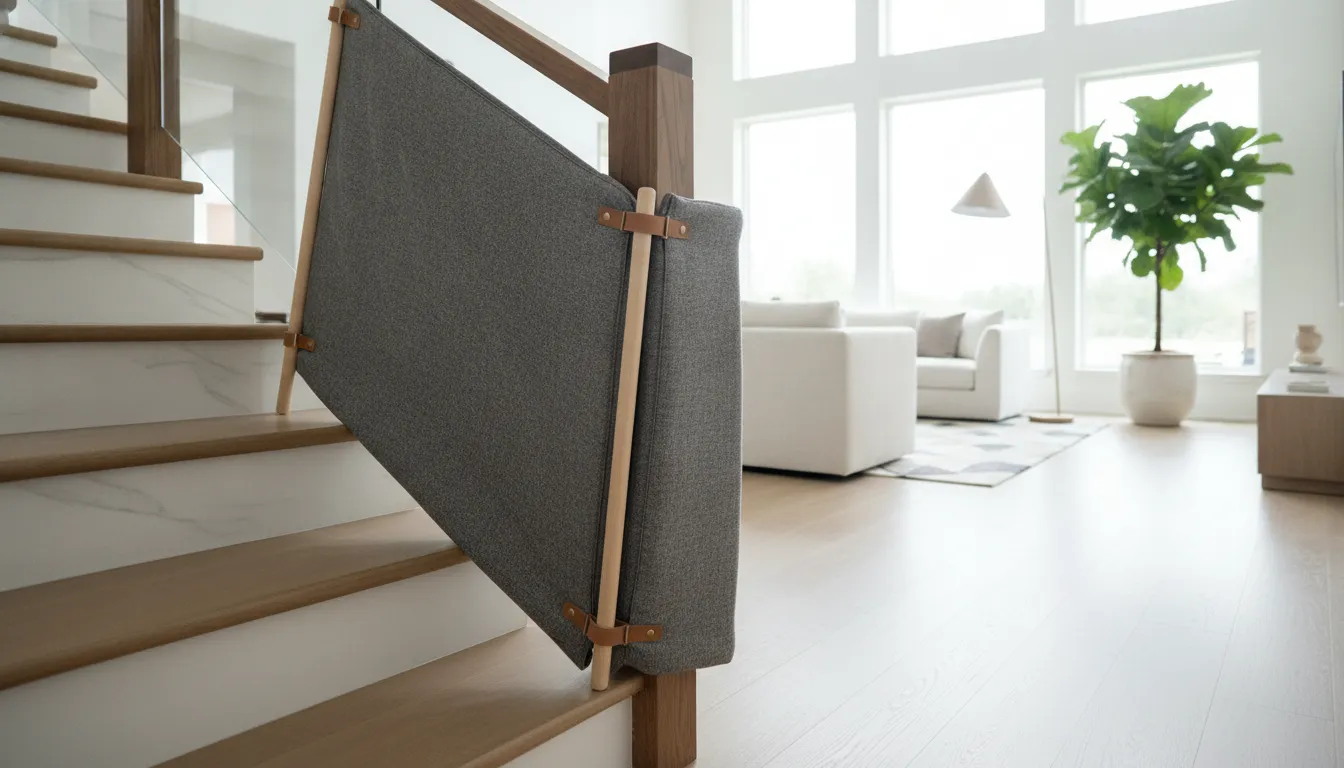
A closer look at banister-to-banister gates
The Stair Barrier's banister-to-banister model secures to compatible banisters without drilling into woodwork. Its upholstery-grade fabric is machine washable, and the panel rolls neatly aside between uses. Explore the available Banister-to-Banister Gates after confirming that the opening has two suitable banisters.
This option differs from a tension gate because it attaches around the banisters instead of pushing against them. It also avoids placing a rigid metal or plastic frame across the opening. Proper fit and setup still matter, and a gate does not replace adult supervision.
Questions to ask before choosing
First, decide whether the opening is a doorway, the bottom of stairs, or the top of stairs. Then note the surfaces on both sides. A no-drill claim only describes the mounting method; it does not confirm that a gate fits every location.
Measure the opening and inspect banister shape, trim, baseboards, and nearby handrails. Review proper gate installation methods before buying or setting up a gate. If the fit remains unclear, share measurements and photos with support rather than guessing.
Use The Stair Barrier fit guide to choose the right stair gate
How Do You Choose the Right No-Drill Baby Gate?
Choose by location first: measure the opening, identify both mounting surfaces, confirm the approved placement, then select the gate style that matches those facts.
The right no-drill baby gate must fit the opening, the mounting surfaces, and the location. Start with the space itself, not a preferred gate style. A careful choice protects finished walls and banisters while helping the gate work as its maker intended.
Measure the full opening
Measure the opening at the top, middle, and bottom because walls and banisters may not be even. Note the narrowest and widest points. Also check baseboards, trim, newel posts, and handrails that could affect where the gate connects.
- Measure: Measure the clear width at each likely connection point, then record every measurement before comparing gate sizes.
- Identify surfaces: Identify both mounting surfaces. Note whether each side is a wall, square banister, round banister, metal railing, or another finished surface.
- Choose the location: Decide exactly where the gate will go. A doorway, bottom landing, and top landing create different fit and use needs.
- Confirm fit: Compare the space with the maker's fit limits and installation directions. Confirm that the listed hardware supports both surfaces and the chosen location.
- Plan daily use: Picture daily use before choosing. Check how the gate opens or stores, how often adults pass through, and whether its look suits the room.
- Ask for help: Ask for help when any detail is unclear. Send clear photos of the whole opening, both mounting points, nearby trim, and your measurements.
Match the method to the location
No-drill describes how a gate connects, but it does not tell you whether every model suits every location. For stairs, do not assume a pressure-mounted gate is appropriate. Review the maker's stated location limits and follow its directions without swaps or shortcuts.
A banister-to-banister space calls for a different setup than a wall-to-banister opening. Use the brand's proper gate installation methods to compare the available layouts. Then confirm that all required connection points remain clear of trim, loose parts, and rail gaps.
Plan for daily life and style
A gate can fit on paper yet become awkward during a busy day. Think about how often adults cross the opening, whether one-handed access matters, and where the gate rests when open. A roll-to-side fabric design may keep a walkway clearer when the barrier is not in use.
Finish the choice by checking fabric, color, cleaning needs, and how the gate will sit beside nearby finishes. These details matter in a visible stairway. If fit remains uncertain, use the questions about installation resource and ask support to review photos before ordering.
Keep the measurements and photos after purchase. They make it easier to check each connection during installation and explain the space if support is needed. A gate is one part of a safer routine, so it should support rather than replace adult supervision.
Why The Stair Barrier fits many no-drill needs
A no drill baby gate often appeals to families who want to protect fine woodwork, rental finishes, or historic details. Yet the way a gate avoids drilling matters. The Stair Barrier uses fabric and wrapped banister connections instead of relying on pressure between two surfaces. Its no-drill option is made for banister-to-banister openings.
A banister-focused no-drill design
The Banister-to-Banister Gates collection is designed to attach without drilling into either banister. This approach can suit renters and homeowners who want to leave finished posts intact. It also avoids treating a pressure-mounted gate as the answer for a stair opening.
Fit still depends on the opening and banister setup. Measure first, then check the model requirements before ordering or installing the gate. The brand's Installation and Support Resources can help families review their setup instead of guessing. A gate should support adult supervision, not replace it.
Fabric made for daily life
The gate is handcrafted in Cornelia, Georgia, from upholstery-grade fabric. Its soft construction offers a different look from bulky plastic or metal gates. Families can choose from a broad range of fabric options to better match the room around the stairs. Safe Never Looked So Good fits this mix of practical use and design.
The fabric is machine washable and dryer safe, which helps with the spills and marks that come with busy homes. When the barrier is not needed, it rolls neatly to the side. The page about roll up fabric safety gates shows why this feature can keep a walkway looking less cluttered.
The lightweight gate is also easy to carry between suitable openings or pack for a trip. That can help grandparents and families who need a temporary barrier. Portability does not change the need to check fit each time. Install the gate as directed whenever it moves.
- Upholstery-grade fabric gives the gate a softer, home-focused look.
- Washable material makes routine care simple.
- Roll-to-side storage keeps the barrier close without taking it down.
- A lightweight build makes the gate easier to move or pack.
Safety standards and the right fit
The Stair Barrier meets ASTM F1004 safety standards. That gives families a clear standard to consider while comparing no-drill choices. Still, no safety standard removes the need for correct setup and close adult supervision. Follow the installation directions and check the gate often during use.
The Banister-to-Banister model answers a specific no-drill need, but it is not a universal fit for every opening. Wall-to-banister and wall-to-wall spaces call for different models and mounting plans. Confirm the opening type, measurements, and install method before choosing a gate.
Frequently Asked Questions
Are no drill baby gates safe for stairs?
No-drill describes the installation method, not whether a baby gate is suitable for stairs. Pressure-mounted gates should not be used on stairs. A no-drill barrier made specifically for banister-to-banister installation may work when it fits the opening and is installed correctly. Always measure first, follow the manufacturer's instructions, and use any gate alongside active adult supervision.
How do no drill baby gates work?
No-drill baby gates secure an opening without putting screws into walls or banisters. Some pressure-mounted models use tension against two flat surfaces. Other designs wrap straps or fittings around banisters. Because these methods handle force differently, parents should confirm the gate's approved location, measure the entire opening, and follow the supplied installation instructions.
Are pressure mounted gates considered no drill?
Yes. Pressure-mounted baby gates are considered no-drill because tension holds them between two surfaces without screws. They are generally intended for suitable doorway openings, not stairs. Pressure can shift when a child pushes, pulls, or climbs on the gate. Check the manufacturer's placement rules and never assume that no-drill also means stair-safe.
Can you use no drill baby gates at the top of stairs?
Do not use a pressure-mounted gate at the top of stairs. If drilling is not possible, look for a no-drill barrier specifically designed for the available banister-to-banister setup. Confirm the opening dimensions, banister shapes, attachment points, and approved placement before installation. The Stair Barrier's installation guides and videos can help families compare suitable configurations.
Ready to choose a no-drill gate that fits?
Waiting to plan your gate can leave you rushing once your child becomes more mobile or spends time near a stairway. Starting now gives you time to measure carefully, review each mounting method, and decide where a no-drill option makes sense for your home. You can also identify stair locations that need a different approach before choosing a gate, rather than discovering fit problems during installation or daily use.
Ready to choose the right Stair Barrier fabric safety gate for your home? Compare banister-to-banister gates now. Then contact The Stair Barrier if you need help confirming your measurements and installation plan before placing your online order with confidence. Request guidance before ordering if anything remains unclear.

Written by Arden Vale
Design & Safety Specialist
Arden provides expert guidance on blending ASTM safety standards with modern interior styling, helping parents and pet owners create secure, beautiful spaces.