


A staircase with curved banisters, offset posts, or an unusually wide opening can make an ordinary baby gate feel like the wrong tool for the job. The right custom baby gate approach starts by matching the gate configuration to the actual opening, not by forcing a standard doorway solution onto a difficult staircase.
Find the right stair gate for your opening and get help confirming the fit.
A custom baby gate for a difficult opening should match the measured width, mounting surfaces, and angle of the space. For banister-to-banister or wall-to-banister stairs, a properly selected fabric safety gate can provide a secure, design-conscious solution without making the staircase feel dominated by bulky plastic or metal.
In this guide, "custom" means choosing a gate around the details of a distinctive home. It does not necessarily mean ordering a one-off size. The Stair Barrier offers premium fabric safety gates in Regular 36" to 43" and Wide 43"+ to 52" sizes. Selecting the correct size and installation type is what creates the tailored result.
No gate removes every risk or replaces adult supervision. A safety gate must be appropriate for its location, installed according to its instructions, and checked regularly. The Stair Barrier meets ASTM F1004 safety standards, giving families a clear standard to consider alongside fit, installation, and daily use.
When does an opening need a custom baby gate approach?
An opening needs a custom baby gate approach when its width, banister shape, mounting surfaces, or angle prevents a conventional doorway gate from fitting as designed. The solution is to document the opening, choose a compatible gate configuration, and confirm that the product's stated size range covers the measured distance.
A straightforward doorway has two parallel, flat sides. Many stair openings do not. One side may be drywall while the other is a round newel post. Two banisters may be different shapes or may not align. The opening can also be wider at one height than another. Those details determine whether a gate can be installed correctly.
Signs that your opening deserves extra planning include:
- One or both attachment points are curved, decorative, or unusually large banisters.
- The wall and banister are offset instead of directly opposite each other.
- The gate must cross the opening at an angle.
- The measured width is outside the range of a typical doorway gate.
- You want to avoid drilling into a finished wood banister.
- The gate will be used near stairs, where a loose or unsuitable installation creates greater risk.
Banister shapes change the attachment plan
Square posts offer obvious flat surfaces, but volutes, rounded posts, metal rails, and decorative trim require a different approach. A rigid gate often expects two flat, parallel mounting faces. A fabric gate designed for banisters can use straps that wrap around the post, allowing it to work with more shapes while avoiding holes in the banister.
For a banister-to-banister opening, both sides use banister attachments. For a wall-to-banister opening, one side connects to a wall-mounted component and the other wraps around the post. Knowing which layout you have is the first decision, because the components are not interchangeable.
Angles and offsets demand honest measurements
An angled opening is not automatically a problem. It is a problem only when a product is installed outside its stated capabilities or measured along the wrong line. Measure between the actual points where the gate will attach, rather than measuring the closest gap between the wall and post. That attachment-to-attachment distance is the span the gate must cover.
If the geometry is unclear, send photographs and measurements for fit guidance. This is safer than assuming that an extension, improvised block, or overtightened gate will solve the issue.
How do custom baby gates work with banisters?
A banister-friendly custom baby gate uses the appropriate attachment on each side of the opening. Straps can secure a fabric barrier to compatible banister posts, while a wall-side installation uses the supplied mounting components. This approach accommodates many post shapes and can create a cleaner visual fit than a rigid gate.
The key advantage of a banister-specific fabric safety gate is that it responds to the architecture already in the home. Instead of requiring two flat surfaces, it can connect across banister-to-banister or wall-to-banister layouts. The result feels considered, especially in open-plan homes where the staircase is always visible.
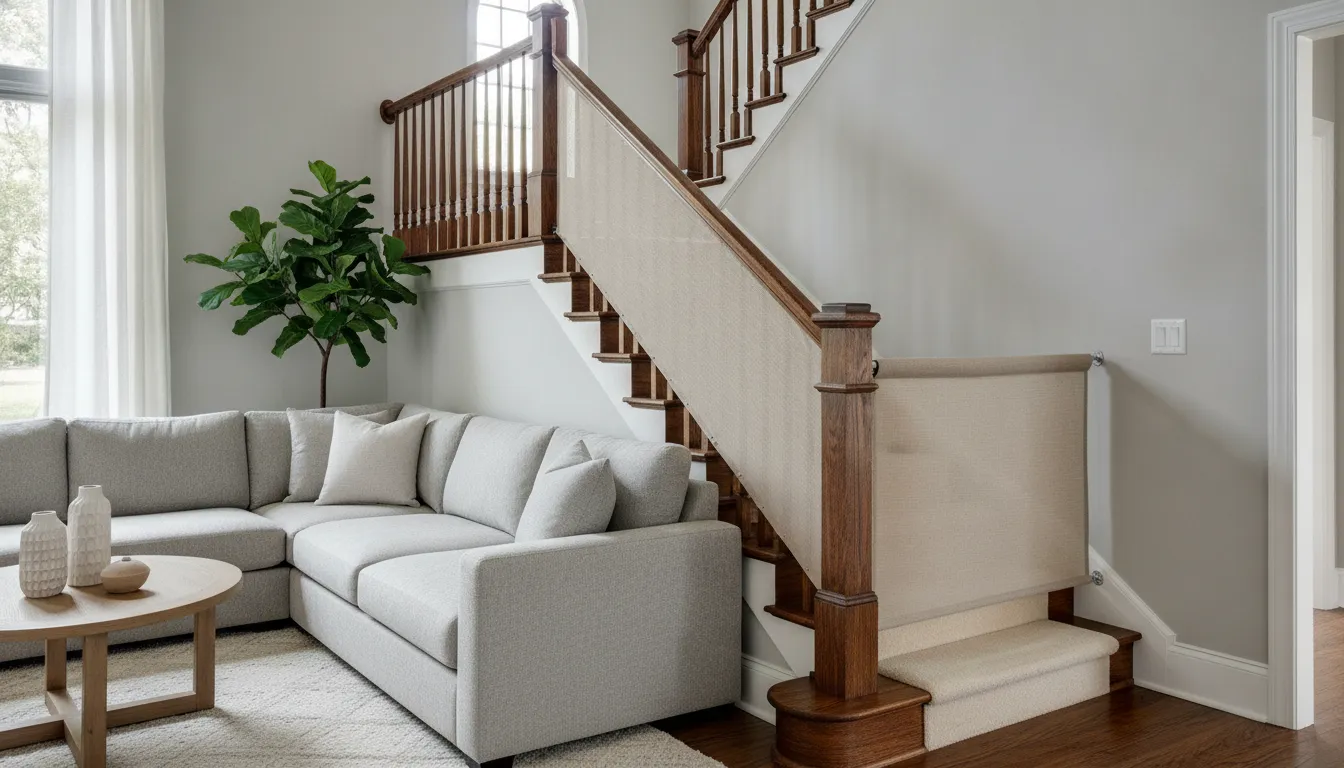
Banister-to-banister installation
This configuration suits an opening with a usable banister post on each side. The Stair Barrier's Banister-to-Banister model requires no drilling into the banisters. Straps secure the sides, and the fabric panel creates a visual barrier across the stair opening. It can also roll neatly to one side when not in use.
Before choosing it, confirm that both posts provide suitable attachment areas and that the span falls within a listed size: Regular 36". To 43" or Wide 43"+ to 52". Measure around unusually large banisters as well, since the post circumference can affect the attachment setup.
Wall-to-banister installation
This layout has a wall on one side and a banister on the other. The wall side uses the proper mounting components, so the location of a stud and the condition of the wall matter. The banister side uses straps. This creates a purpose-built connection without treating the wall and post as if they were identical surfaces.
Families comparing layouts can read more about the reasoning behind custom baby gates for a custom home. When both sides are banisters, review the Banister-to-Banister fabric safety gate. For a mixed opening, compare the Wall-to-Banister fabric safety gate. The most important takeaway is simple: the gate type must match both sides of the opening.
Why fabric works in design-conscious homes
A premium fabric panel brings practical and visual advantages. The Stair Barrier is lightweight, machine-washable and dryer-safe, and available in 20+ upholstery-grade fabric options. Colors such as Midnight, Silverstone, Sandstone, Ivory Cloud, Charcoal Linen, Pebble Gray Linen, Classic Navy Linen. Parchment Linen, and Pacific Blue Linen make it easier to coordinate the gate with the room.
Fabric does not make correct installation optional. Check straps, buckles, and mounting components regularly, follow the product instructions, and continue supervising children and pets as appropriate.
How do you measure an angled or offset opening?
Measure an angled or offset opening between the exact points where the gate will attach, both near the floor and at the intended upper attachment height. Record the mounting surfaces, post shapes, and angle, then take clear photos. If the two width measurements differ, ask for fit confirmation before ordering.
Good measurement prevents most fit surprises. Use a rigid metal tape measure, write down each number immediately, and do not round a borderline width down. An opening that appears square from across the room may change by an inch or more between the floor and the top attachment point.
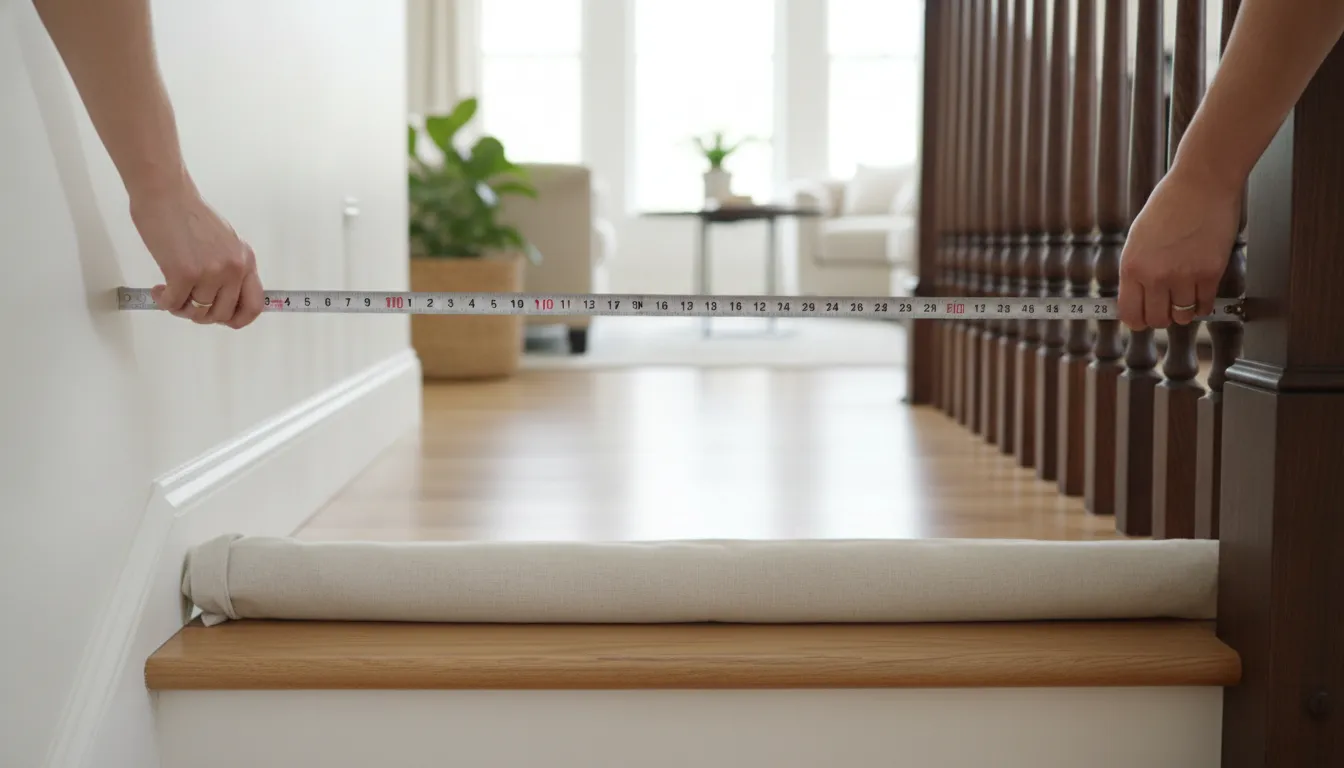
A six-step measurement process
- Identify the exact left and right attachment points.
- Measure the distance between those points near the floor.
- Measure again at the intended upper attachment height.
- Note whether each surface is a wall, square post, round post, metal rail, or decorative banister.
- Photograph the opening straight on and from each side so the angle is visible.
- Compare the measurements with the gate's listed range and request fit help if anything is unclear.
Account for the real attachment line
For offset posts, a tape held straight across the narrowest part of the opening can produce the wrong number. The gate travels between its two installed attachment points, so measure along that line. If one point sits farther back, the diagonal distance may be longer than the apparent opening.
Also inspect the area around each attachment point. Baseboards, trim, handrails, or nearby steps can affect where mounting components sit. A wide photo helps a fit specialist see obstacles that a close-up might hide.
Do not improvise around uncertainty
If a measurement lands close to 43" or 52", or the top and bottom values differ, do not guess. Use The Stair Barrier's gate selection and fit guidance to confirm the correct configuration. Photo-based support is especially useful for curved posts and unusual angles.
What works best for extra-wide openings?
The best gate for an extra-wide opening is one explicitly rated for the measured span and compatible with the mounting surfaces. For difficult stair openings between 43"+ and 52", The Stair Barrier's Wide fabric safety gate may fit when selected in the correct banister-to-banister or wall-to-banister configuration.
Width affects more than reach. A gate that is stretched beyond its listed range or assembled with unapproved extensions may not perform as designed. Start with the measured attachment-to-attachment span, then compare only products intended for that distance and location.
Compare gate types by the opening, not convenience
| Gate approach | Best fit | Angle flexibility | Key consideration |
|---|---|---|---|
| Banister-friendly fabric safety gate | Banister-to-banister or wall-to-banister openings within its listed range | Can accommodate angled installations when confirmed | Choose the exact configuration and size |
| Rigid hardware-mounted gate | Compatible solid mounting surfaces | Varies by model | Confirm stair location approval and required hardware |
| Pressure-mounted gate | Only locations allowed by the product instructions | Generally needs parallel surfaces | Do not assume it is appropriate for stairs |
Why the listed width range matters
The Stair Barrier's Regular size covers 36" to 43", while Wide covers 43"+ to 52". These are standardized sizes designed to adjust within their ranges. Although shoppers often call a solution for an unusual staircase a custom baby gate, The Stair Barrier no longer offers fully bespoke made-to-order dimensions. The correct goal is a verified fit within the available configuration.
For openings beyond the stated range, ask for guidance rather than assuming a fabric panel can simply stretch farther. Extension straps address certain large banister circumferences; they do not automatically increase the gate's approved opening width.
Keep wide openings visually calm
A long metal or plastic barrier can become the dominant feature in a room. A fabric safety gate offers a softer visual plane and upholstery-grade color choices, helping a necessary safety product blend with nearby furnishings. This is where The Stair Barrier's "Safe Never Looked So Good" positioning becomes practical rather than decorative.
How do you choose the right custom baby gate?
Choose a custom baby gate by matching four facts: where it will be used. What surfaces it will attach to, the measured width, and how the gate fits daily life. Then verify the safety standard, installation instructions, fabric care, and support options before selecting a color or pattern.
The best choice is not simply the gate with the most features. It is the gate whose design matches your opening and whose daily operation works for your household. Make fit and installation non-negotiable, then compare aesthetics and convenience.
Use this decision checklist
- Location: Identify whether the gate is for a stair opening, doorway, or another area.
- Configuration: Choose banister-to-banister, wall-to-banister, or a different compatible setup.
- Width: Confirm that every relevant measurement falls within the stated product range.
- Mounting: Check post shape, circumference, wall stud location, and required components.
- Safety: Look for the applicable standard and follow all installation and use instructions.
- Daily routine: Consider access, cleaning, storage, children, pets, and visitors.
- Design: Select a material and color that can live comfortably in the room.
Prioritize verified safety details
The Stair Barrier meets ASTM F1004 safety standards. That is an important product qualification, but safe use still depends on choosing the right configuration, installing it correctly, and checking it over time. No gate should be described as eliminating risk, and no safety product replaces attentive adult supervision.
For stair locations, be especially cautious with advice that treats all gate types as interchangeable. A pressure-mounted gate should not be assumed safe for stairs. Follow the manufacturer's location guidance and ask questions before purchase if the use case is uncertain.
Choose convenience that supports consistent use
A safety gate works best when the household can use it as intended every day. The Stair Barrier's fabric panel rolls to the side when not in use and can be machine washed and dried. Its lightweight construction also makes it practical for families who may move it for travel, subject to correct installation at every location.
Explore The Stair Barrier's fabric safety gate collection to see how fit, fabric, and design work together. Select style only after confirming the functional requirements.
What should you confirm before ordering?
Before ordering, confirm the opening's top and bottom widths, the exact mounting surfaces, the required gate configuration, and whether every measurement fits the listed range. Review installation and care instructions, verify any needed accessories, and request photo-based guidance instead of guessing about an angle, post, or wall.
A final review takes only a few minutes and can prevent choosing the wrong size or mounting setup. Treat your measurements, photographs, and product specifications as one package. If any piece conflicts with another, pause and ask for support.
Final pre-order checklist
- The location and intended use match the product instructions.
- The opening was measured at more than one height.
- The attachment-to-attachment distance is within the listed size range.
- You identified both mounting surfaces and any angle or offset.
- A suitable wall mounting location is available where required.
- You confirmed whether unusually large banisters need compatible accessories.
- You reviewed installation, operation, washing, and regular inspection guidance.
- You selected the fabric only after confirming the gate configuration.
Confirm fit before relying on a product
Do not wait until installation day to resolve a questionable measurement. Clear photos can show the relationship between the banister, wall, handrail, trim, and first stair tread. The support team can then help identify a suitable model or explain when the opening needs another solution.
Once installed, inspect the gate according to its instructions. Check that attachments remain secure and that the panel and hardware show no damage. Recheck after washing, travel, or any time the gate has been removed and installed again.
Frequently Asked Questions
What are the benefits of a custom baby gate?
A custom-fit baby gate can address banisters, angled mounting points, and wider-than-standard openings while complementing the room. The best option fits the measured opening, uses the correct mounting method, and meets the applicable safety standard. A premium fabric gate also offers a softer look, washable material, and convenient side storage.
Are custom safety gates safe for the top of stairs?
A gate used at the top of stairs should be specifically designed and installed for that location, securely mounted, and used according to its instructions. Never assume that a pressure-mounted gate is appropriate for a stair-top opening. Confirm the intended location and installation method with the manufacturer before relying on the gate.
How do I choose a baby gate for uneven openings?
Measure the opening at the intended attachment height and near the floor, identify each mounting surface, note any offset or angle, and photograph the entire area. Ask the manufacturer to confirm the fit before ordering if any measurement or mounting point is uncertain.
Can I use custom baby gates for pets?
Many fabric safety gates can also help manage where pets go in the home. Choose the gate according to the pet's size and behavior, install it exactly as directed, and continue supervising as appropriate. A determined pet that jumps, climbs, or chews may require a different solution.
Ready to find the right baby gate for your stairs?
The right custom baby gate starts with a clear picture of the opening: location, width, angle, banister shape, and wall condition. Match those facts to a compatible configuration, then confirm the fit before ordering. That process protects both the function of the gate and the considered look of your home.
A difficult staircase does not have to force a choice between safety planning and interior style. With accurate measurements, the right mounting configuration, and premium washable fabric, a gate can feel like it belongs in the home rather than interrupting it.
Use the fit guide to find the right stair gate for your opening.

Written by Arden Vale
Design & Safety Specialist
Arden provides expert guidance on blending ASTM safety standards with modern interior styling, helping parents and pet owners create secure, beautiful spaces.