


Your toddler is getting taller, your dog can clear a low barrier, and the gate at the stairs suddenly feels less suited to the household. A tall baby gate is worth considering when extra vertical coverage addresses a specific need. Height alone is not enough: mounting, fit, placement, and everyday use matter just as much.
Find the right fabric safety gate for your exact stair configuration.
The best gate fits the exact space, suits the people and pets using it, and remains practical enough to use consistently. Extra height can solve a real household concern, but it cannot compensate for poor fit or unsuitable mounting. No gate eliminates all risk or replaces adult supervision. Always follow the manufacturer's installation and use instructions.
This guide explains when added height matters, how tall gates compare with standard-height options, and what to measure before buying. It also explores why an attractive fabric safety gate may make more sense than a bulky rigid barrier in a prominent staircase.
When does a tall baby gate make sense?
In short: A tall baby gate makes the most sense when it addresses a specific concern, such as a taller toddler, a larger dog, or a mixed child-and-pet household. Height should be considered together with behavior, mounting, fit, and how the barrier will be used every day.
Your child is growing or starting to climb
Children develop at different rates. Some become curious climbers early, while others are tall enough that a standard gate begins to feel less substantial. In those situations, a taller barrier creates more vertical distance between the child and the top edge. It may also make the barrier feel more clearly defined in a busy household.
Height should never be treated as permission to leave a child unattended. Watch for signs that a child is trying to climb, pull on, or operate any gate. Follow the product's age and use guidance, and reassess the setup as the child grows or develops new abilities.
You need a barrier for a larger pet
Pet owners often search for tall baby gates because a taller dog may be able to see over or jump a shorter barrier. Consider the animal's height, jumping ability, temperament, and persistence. A gate that works for a calm dog may not suit an athletic jumper or a pet that repeatedly pushes or chews barriers.
Also consider what the pet can see through or over the gate. Some animals settle more easily behind a visual boundary, while others become more determined when separated. For more pet-specific planning, review The Stair Barrier's guidance on choosing a pet gate for stairs.
One gate must work for children and pets
Mixed-use households need to evaluate more than height. Look at how the gate mounts, whether adults can manage it comfortably, whether small pets can get around it, and how the material holds up to ordinary use. The goal is a boundary that works for the whole household without making the home feel like a collection of temporary obstacles.
Tall baby gate vs. standard-height gate
Quick answer: A tall gate offers additional vertical coverage, while a standard-height gate may be easier to manage and less visually prominent. Neither is inherently better. The right choice is the one with the correct fit and mounting method for the location, plus enough height for the household's specific need.
| Consideration | Standard-height gate | Tall baby gate |
|---|---|---|
| Typical need | Everyday child-focused boundaries | Taller children, larger pets, or mixed use |
| Visual presence | Usually less prominent | More noticeable in the room |
| Adult access | May feel easier to reach or manage | Needs careful attention to daily usability |
| Selection priority | Correct fit and mounting | Correct fit and mounting, plus useful extra height |
Instead of starting with a target number, begin with the reason you want more height. Then compare products suitable for the opening and installation surface. A tall gate poorly matched to the space is not a good trade for a correctly fitted gate.
Labels can be misleading because manufacturers and retailers do not all define "tall" or "extra tall" in the same way. Check the actual dimensions. The Stair Barrier's Banister-to-Banister and Wall-to-Banister fabric models are each 32 inches high. So shoppers should compare that verified measurement with their needs rather than relying on a category label.
Where will you install the gate?
Location matters as much as height: Doorways, hallways, the bottom of stairs, and the top of stairs each create different mounting and traffic-flow demands. Identify the exact attachment surfaces on both sides before shopping, especially when round banisters, square posts, trim, or walls meet the opening.
At the top of stairs
The top of a staircase deserves careful planning because an unsuitable or misplaced gate can introduce a serious hazard. Do not assume a pressure-mounted gate is appropriate for a stairway. Choose a gate and installation approach specifically intended for the location, follow all manufacturer instructions, and confirm that the attachment surfaces support the required connections.
Think about the landing as well as the opening. Adults need enough stable space to operate or remove the gate as directed. A product that swings into an awkward area or leaves a tripping bar in the path may not suit that stair layout. The brand's baby gate buyer's guide provides a useful starting point for comparing configurations.
At the bottom of stairs
At the bottom, determine where the gate will sit relative to the first step and how it will connect on both sides. Banister-to-banister and wall-to-banister spaces often require a different solution than a conventional doorway. Measure the actual mounting points, not just the widest visible area around the staircase.
Across a doorway or hallway
Doorways and hallways can appear simpler, but trim, baseboards, hinges, and uneven walls may still affect fit. Consider traffic flow too. A barrier that stays in the way for most of the day can become frustrating. A fabric gate that rolls neatly to the side may help the opening feel more usable when the barrier is not needed.
How to measure for a tall baby gate
Measurement summary: Identify the exact installation location and both attachment surfaces, then measure at the intended connection points. Account for baseboards, trim, handrails, and other obstructions. Compare those measurements with the product's stated fit range, and ask for help rather than guessing about an unusual stairway.
- Choose the exact installation location. Decide whether the gate will sit at a doorway, hallway, top of stairs, or bottom of stairs.
- Identify both mounting surfaces. Note whether each side is a wall, round banister, square post, trim surface, or another structure.
- Measure at the intended connection points. Do not rely on a rough wall-to-wall estimate if the gate will attach to banisters or posts.
- Check for obstructions. Record baseboards, trim, handrails, molding, and other details that could change alignment.
- Compare the measurement with the fit range. Confirm width, height, and installation requirements before ordering.
- Ask for help with unusual spaces. Use measuring resources or photo-based support rather than guessing about a stair configuration.
Measure more than once and write the numbers down. If two measurements differ, investigate why before choosing a gate. Stairways are often less symmetrical than they look, particularly when banisters taper or decorative trim changes the available attachment surface. The gate comparison chart can help you connect those measurements to available configurations.
Watch the installation videos before ordering to understand how each configuration connects.
Why fabric changes the tall-gate conversation
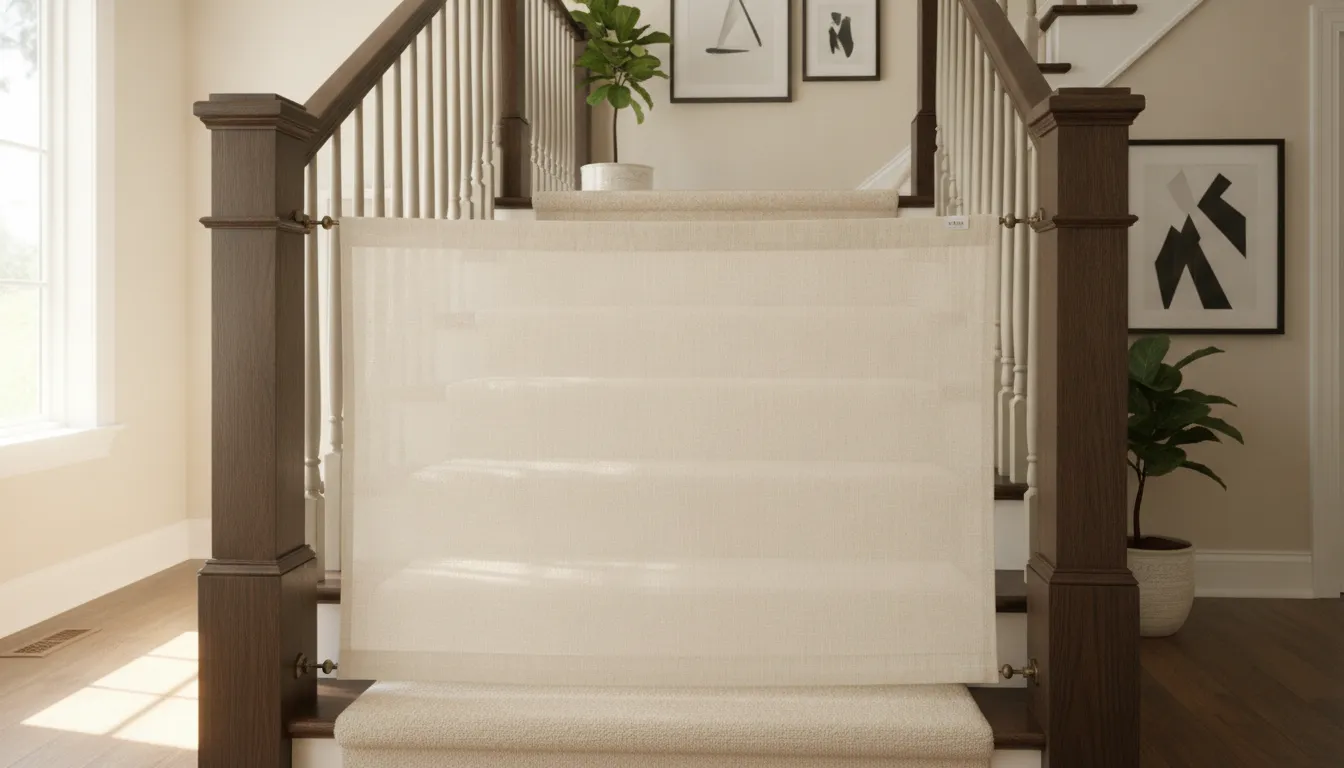
Why fabric matters: A fabric safety gate can define a boundary without adding the hard, bulky appearance associated with many metal or plastic gates. Washable material, lightweight construction, multiple fabric choices, and roll-to-side storage make the barrier easier to integrate into a thoughtfully designed home.
A softer visual presence
Many shoppers picture a tall gate as a large metal frame or a conspicuous plastic barrier. The Stair Barrier offers more than 20 upholstery-grade fabric options, giving families a way to choose a look that works with the home rather than against it. That flexibility supports the brand's idea that Safe Never Looked So Good.
A softer visual presence matters most in prominent spaces. A staircase may sit at the center of an entryway or open living area, where a bulky gate becomes part of the room's first impression. Shoppers can explore the brand's fabric safety gate collection to compare colors, patterns, and configurations.
Practical care and storage
Machine-washable and dryer-safe fabric simplifies routine care. Lightweight fabric construction can also be easier to handle than a bulky rigid gate. When the barrier is not needed, the design rolls neatly to one side so the opening can feel more open without storing a large gate panel elsewhere.
Options for stair-specific layouts
Fabric gates can be especially useful where traditional gates are awkward, including banister-to-banister and wall-to-banister installations. The Banister-to-Banister model connects between two banisters without drilling. The Wall-to-Banister model uses minimal drilling on the wall side. Each space still needs careful measuring, and buyers should select the correct configuration rather than assuming one style fits every opening.
The Stair Barrier meets ASTM F1004 safety standards. That is an important product consideration, but it does not eliminate every risk or replace supervision. Correct selection, installation, use, and regular checks remain essential. Review the brand's product features for more detail about materials and operation.
What features matter beyond extra height?
Look beyond the top edge: The most useful gate balances correct mounting, verified fit, adult usability, easy care, convenient storage, and an appearance suited to the room. Height can be valuable, but these practical details determine whether the gate truly works for a household over time.
- Correct mounting for the location: Confirm that the gate is designed for the intended doorway or stair position.
- A verified fit range: Match the product to measurements taken at the actual attachment points.
- Adult usability: Consider how adults will open, close, move, or store the barrier during a typical day.
- Material and maintenance: Choose material suited to household traffic and cleaning needs.
- Storage behavior: Decide whether a swinging panel, removable gate, or roll-to-side design makes the most sense.
- Appearance: Choose a gate you will be comfortable seeing every day, especially at a prominent staircase.
Plan to inspect the gate regularly. Household use, cleaning, curious hands, and pets can all affect how a barrier sits over time. Follow the manufacturer's maintenance guidance, and stop using a product if it appears damaged or no longer fits as intended.
Common tall-gate shopping mistakes to avoid
The biggest mistake is shopping by height alone. A tall gate still needs to connect correctly to the actual walls, posts, or banisters. Other common errors include measuring the widest visible opening instead of the attachment points, overlooking daily traffic flow, and assuming one mounting style works everywhere.
Families sometimes overlook how a barrier fits daily routines. Consider who will use the opening, how often adults need to pass, and what happens when the barrier is not needed. A gate that is awkward to manage may be used inconsistently. Roll-to-side storage can keep the path more open while maintaining a softer visual presence.
Finally, do not rely on a broad product label alone. Read the product details, confirm its intended location, and ask for measuring help when the space is unusual. The brand also publishes guidance about when The Stair Barrier is not the right fit, which can help shoppers make a more informed decision.
Frequently asked questions about tall baby gates
What height is considered a tall baby gate?
There is no single universal height that defines every tall gate. Retailers and manufacturers use terms such as tall and extra tall differently. Compare the listed dimensions with your household's needs, intended user, and installation location instead of relying on the label alone.
Are tall baby gates better for stairs?
Not automatically. Height alone does not determine whether a gate is appropriate for stairs. The mounting method, product instructions, exact stair position, and fit are critical. Do not assume a pressure-mounted option is suitable for a stairway. Select a stair-appropriate product and follow its installation instructions.
Can a tall baby gate also work as a pet gate?
It may, depending on the product and pet. Consider the animal's size, jumping ability, behavior, and tendency to push or chew. Confirm that the gate is intended for the planned use and location, and supervise as needed.
How do I choose between a wall-to-banister and banister-to-banister gate?
Identify the attachment surface on each side of the opening. If both sides are banisters, look for a banister-to-banister configuration. If one side is a wall and the other is a banister, choose a wall-to-banister configuration. Use the manufacturer's measuring guide or photo-based support when uncertain.
Does a taller gate replace adult supervision?
No. A gate is one part of a broader home-safety approach and does not eliminate all risk. Adults should supervise children, follow the manufacturer's use guidance, and regularly check that the gate remains correctly installed and in good condition.
Find a fabric safety gate that fits your space
The right tall baby gate solves a real need without overwhelming the home or complicating everyday movement. Start with the installation location, measure carefully, and choose height only after confirming fit and mounting. That approach helps narrow the options to barriers that work in the real space, not just in a product photo.
Find the right The Stair Barrier configuration for your staircase.
For an attractive alternative built around stair-focused configurations, washable fabric, and roll-to-side storage, browse The Stair Barrier's fabric safety gate options. If the opening is unusual, use the site's measuring resources and product guidance before choosing rather than guessing about fit.

Written by Arden Vale
Design & Safety Specialist
Arden provides expert guidance on blending ASTM safety standards with modern interior styling, helping parents and pet owners create secure, beautiful spaces.