

The Stair Barrier is a fabric safety gate for homes that want a stair or doorway blocked without a plastic frame in the middle of the room. The panel is upholstery-grade fabric, not metal bars, and it is made for openings that run from a wall to a banister or from banister to banister. If one side of your stairs is a wall, the wall-to-banister model is the configuration that matches that opening.
What Is The Stair Barrier?
The Stair Barrier is a direct-to-consumer fabric safety gate for design-conscious parents, pet owners, and grandparents. The brand line is "Safe Never Looked So Good," and the product is meant to sit in a finished home rather than look like a temporary plastic gate. It is sold from the Shopify store at thestairbarrier.com. The two stair configurations cannot be swapped after you order: wall-to-banister, and banister-to-banister.
The fabric panel is the whole barrier. Vertical struts and horizontal webbing sit inside the fabric, so there is no top rail or horizontal bar a child can use as a step. When the buckles are released, the panel rolls to one side and stays rolled and upright. That is the practical difference from a bulky metal or plastic gate: the opening is covered when you need it, and the panel moves aside when you do not.
The Stair Barrier is primarily designed for the bottom of the stairs. A top-of-stairs install is a separate decision. It must follow the product's own install guide, it must not sit directly at the stair edge, and it needs a minimum 10-inch setback. Hardware mounting does not remove a climbing hazard. If a child can climb over the gate, stop using it and follow the manufacturer's safety instructions. No gate replaces adult supervision.
How the Fabric Panel Covers an Opening
On a wall-to-banister stair, one side of the opening is drywall or trim and the other is a banister. The wall side is mounted with the installation kit that ships with the gate: brackets, a rod, screws, anchors, and spacers for molding. The banister side attaches with straps and three dual-sided release buckles. You do not drill into the banister. To open the stairs, undo the buckles and roll the panel to the side.
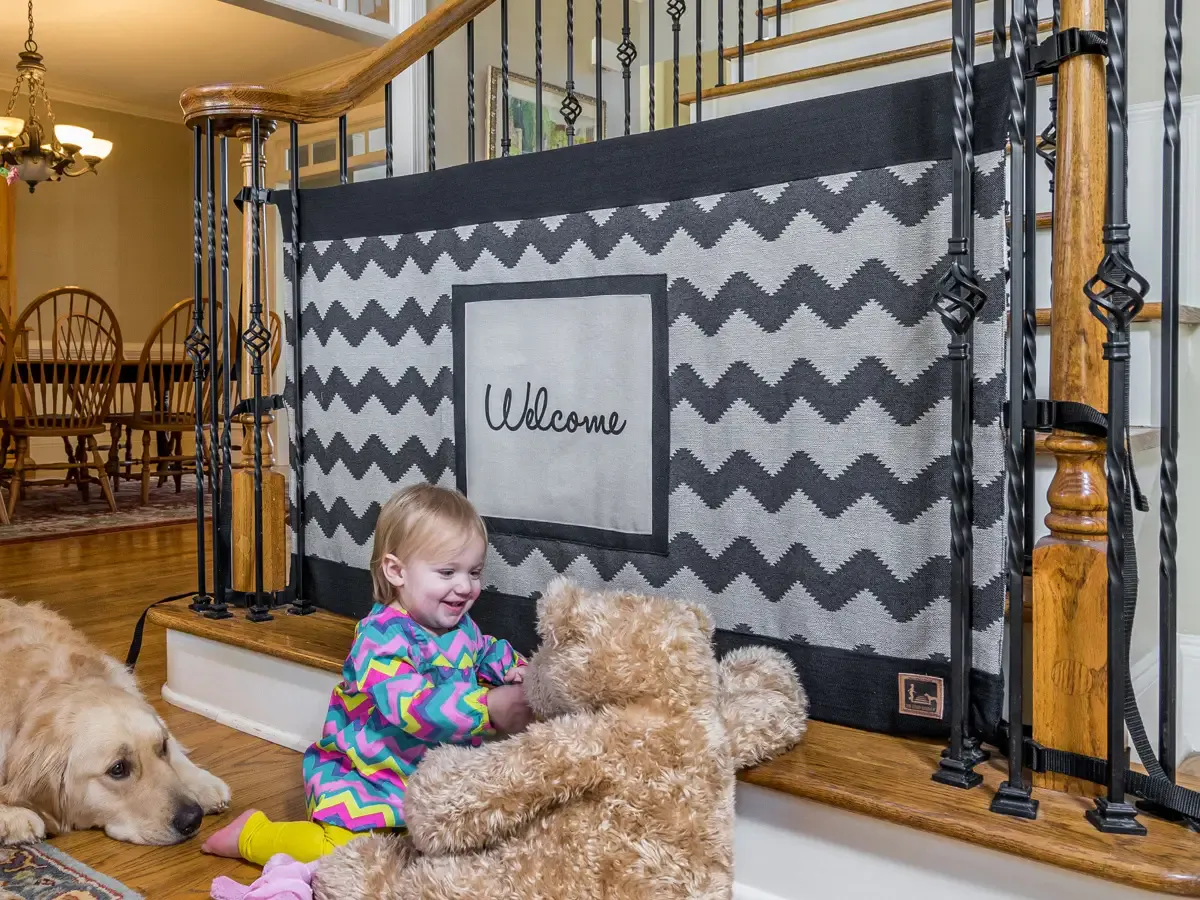
The panel is 32 inches tall on both the wall-to-banister and banister-to-banister gates. It is sized to the clear opening, not to the whole staircase. Regular covers 36 to 43 inches. Wide covers openings over 43 inches up to 52 inches. Fifty-two inches is the absolute maximum these two sizes support. Choosing the smaller size near 43 inches only picks between Regular and Wide. It does not stretch the gate past 52 inches. If the measurement is unusual, or you are between sizes and not sure, send a photo to support rather than guessing.
The fabric is removable. Follow the care instructions for the fabric you chose before washing or drying. Hardware and frame parts are wiped clean. They do not go in the machine. Alpine fabrics are for indoor use. RELEZ fabrics are the indoor/outdoor option. Outdoor suitability does not apply to the Alpine indoor collection.
Because the panel is fabric, it also blocks the view through the opening. A bar gate lets a child see the steps. A fabric panel does not. That is useful at the bottom of a stair, and it is the same reason some households use the gate across a doorway they want closed without a swinging door.
When the Wall-to-Banister Configuration Is the Right Fit
Choose wall-to-banister when one side of the opening is a wall and the other is a banister. That is the setup most pressure-mounted gates struggle with, because a pressure gate wants two flat faces and is not the right tool at the top of a stair. The Stair Barrier wall-to-banister gate is built for that mixed opening. The product page shows the current price for each fabric and size. Current list prices can change.
Choose banister-to-banister instead when both sides are banisters. That model does not need a wall, and it does not require drilling. The banister-to-banister gate weighs under 6 lbs and includes a carry bag for travel. The two configurations are different products. You cannot convert one into the other after it arrives.
Use the table as a first sort, then confirm the opening on the product page or with a photo to support.
| What you have | Configuration | How it attaches | Opening it covers |
|---|---|---|---|
| Wall on one side, banister on the other | Wall-to-banister | Mounting kit on the wall, straps and buckles on the banister | Regular 36–43 in. Wide: over 43 in., up to 52 in. |
| Banister on both sides | Banister-to-banister | Straps and buckles. No drilling. Includes a carry bag. | Same two sizes. 52 in. is the ceiling. Weighs under 6 lbs. |
| Over 52 in., or an odd width | Ask support first | Do not stretch Wide | Send a photo |
A doorway with two flat walls is a different question from a stair with one banister. If you need a fabric gate for a doorway, hallway, or open span with no banister, that is the sister brand, Crafted Gates, and it is the only retractable fabric gate on the market. Stair suitability depends on the specific Crafted Gates model and its installation requirements. Check the individual listing before treating one as a stair gate. The Stair Barrier itself is the fabric panel gate for banister openings.
What the Safety Standard Covers, and What It Does Not
The Stair Barrier is designed to meet ASTM F1004 safety requirements for stair gates. ASTM F1004 is the Standard Consumer Safety Specification for Expansion Gates and Expandable Enclosures. The U.S. Consumer Product Safety Commission incorporates that standard into the federal safety standard for gates and enclosures. In the 2020 final rule, the Commission described these products as intended for young children age 6 months through 24 months. That range is the intended product age range. It is not a judgment about when a particular child is ready to use stairs alone.
Meeting the standard does not mean the gate removes every risk. Climbing, a gate used past the point a child can get over it, and a top-of-stairs install placed at the nosing are separate problems. Keep product limits, the child's development, and household supervision distinct. There is no universal week to take a gate down, and there is no rule that the bottom gate always comes out first. Those decisions depend on the child, the house, and the manufacturer's instructions.
Fabrics, Care, and Everyday Use
The wall-to-banister product page lists fabric by collection, and the current page is the list to order from. Approved color names include Midnight, Silverstone, Sandstone, and Ivory Cloud, plus the linen colors Charcoal Linen, Pebble Gray Linen, Classic Navy Linen, Parchment Linen, and Pacific Blue Linen. The live store also announces RELEZ Stripes indoor/outdoor fabric in three colors: Sand, Pebble, and Navy. Pick the fabric for the room the gate will live in. A stair that faces a living room wants a different cloth than a covered porch. If a color name on the product page does not match this list, use the name on the page.
The panel rolls to the side so the stair stays usable for adults. The included carry bag is confirmed on the banister-to-banister model, which is the travel setup. Do not assume the wall-to-banister kit includes that bag unless the current wall-to-banister product page says so. The wall-to-banister model is lightweight. Do not treat the banister-to-banister "under 6 lbs" wording as this model's spec. If you need the exact weight before you travel, check the current product page.
Wash the fabric on the cycle its care label allows. Spills and pet messes are the usual reason people wash it. Do not machine-wash the brackets, rod, or buckles. If a strap, spacer, or dowel needs replacing, contact support and confirm compatibility and current availability before you order a part. Configurations are not interchangeable, and a part from one setup is not automatically right for the other.
Pets, Doorways, and the Same Panel
The same fabric panel is what many households use for a dog at the bottom of the stairs. It is still a stair gate first. It does not become a different product because the animal is a pet. Height, the roll-to-side opening, and supervision all still apply. A dog that can jump the 32-inch panel, or a cat that treats the top edge as a shelf, is a sign to stop relying on the gate for that animal.
A doorway is in range only when the opening matches a published size and one side is a banister you can strap to, or a wall you can mount. Two flat walls, a wide hall, or an opening with no banister is not this configuration. That is the case for Crafted Gates, the sister brand, and only after you check that model's own stair rules. Not every Crafted Gates model is suitable for stairs.
Grandparents who set the gate up for a visit can roll it aside between uses and pack the banister-to-banister model, which is the one with the carry bag and the under 6 lbs weight. The wall-to-banister model stays mounted on the wall side, so it is the better everyday gate and the worse travel gate. Decide that before you order, not after the kit is on the wall.
How to Decide Before You Order
Measure the clear opening where the panel will sit, from the wall face to the banister, at the height the gate will hang. Write down Regular or Wide only after that number is inside 36 to 43 inches, or over 43 and at most 52. Then look at the wall. Molding thicker than the included spacers, a curved volute, or a banister you cannot strap to is a photo for support, not a guess in the cart.
Read the install video for the wall-to-banister gate before you drill the wall side. The kit is included, so you should not need a separate mounting kit for a standard install. Extra spacers exist for thicker molding. Confirm those with support if your trim is unusual. Pressure-mounted gates are a poor match for this opening because they can feel unsafe on stairs. This gate is hardware-mounted on the wall for that reason. Mounting hardware still does not make the gate climb-proof.
If the opening is two banisters, stop and look at the banister-to-banister gate instead of forcing a wall mount onto a post. If the opening has no banister at all, this product is the wrong configuration. The guide to finding the right stair gate is the short version of that choice.
Review wall-to-banister fabrics and sizes
Frequently Asked Questions
What is The Stair Barrier?
The Stair Barrier is a premium fabric safety gate for stair and doorway openings. A fabric panel, held by internal struts and webbing, covers the opening and rolls to the side when you release the buckles. It is made for homes that do not want a plastic or metal gate as the focal point of the stair.
When should I choose the wall-to-banister gate?
Choose it when one side of the opening is a wall and the other is a banister. The wall side uses the included mounting kit. The banister side straps on without drilling into the banister. If both sides are banisters, order the banister-to-banister gate instead. The two cannot be swapped after purchase.
What opening widths does it fit?
Regular fits 36 to 43 inches. Wide fits openings over 43 inches up to 52 inches. Fifty-two inches is the maximum. An unusual measurement should go to support with a photo, not into a stretched size.
Can I use it at the top of the stairs?
The Stair Barrier is primarily designed for the bottom of the stairs. A top-of-stairs install has to follow the product's own guidelines, cannot sit directly at the stair edge, and needs a minimum 10-inch setback. Not every setup is suitable for the top of the stairs.
Does meeting ASTM F1004 mean my child is ready for stairs?
No. ASTM F1004's 6-to-24-month range is the intended product age range for expansion gates and enclosures, as the Consumer Product Safety Commission described it when it adopted the standard. It does not say when your child can use stairs independently. If a child can climb the gate, stop using it.
A Gate That Belongs in the Room
The Stair Barrier is the fabric panel, the two published sizes, and a configuration that matches the opening you actually have. For a wall on one side and a banister on the other, that configuration is wall-to-banister. Measure once, stay inside 52 inches, and use the product page to compare fabrics before you order.
For a doorway or hallway with no banister, look at Crafted Gates, the sister brand and the only retractable fabric gate on the market. Whether a given Crafted Gates model works on stairs depends on that model and its installation requirements. Verify the listing rather than assuming every model is a stair gate.
These pages go deeper than this overview.
- What makes The Stair Barrier different.
- The wall-to-banister safety gate guide.
- How to install a wall-to-banister baby gate.
- Fitting a gate where a wall meets a banister.
- How wide these gates can go.
- The configuration comparison chart.
- The wall-to-banister install video.
- How the panel rolls to the side.
- The fast FAQ.
- The banister-to-banister fabric safety gate.
Use the banister-to-banister gate only when both sides of the stair are posts.